
Keeper care guide
Ball python
Python regiusAbout this species
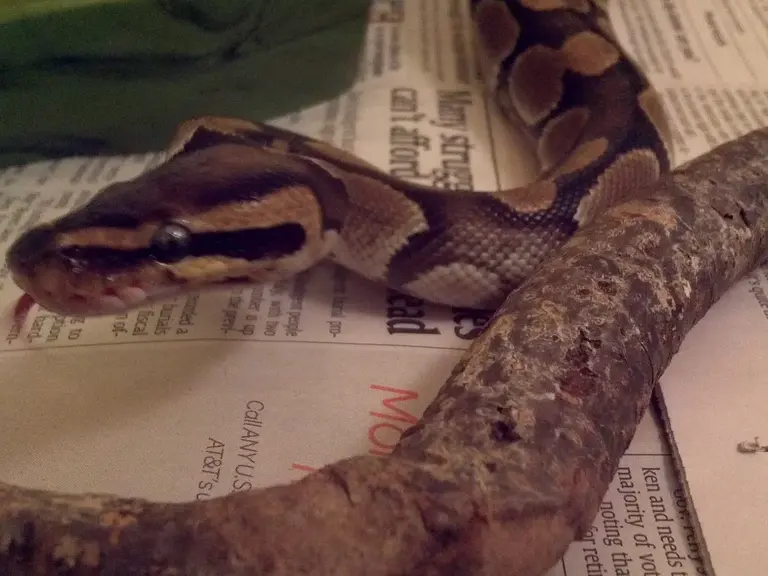
What kind of animal is a ball python?
A ball python is a medium-sized constricting snake from the grasslands, savannas, and forest edges of West and Central Africa. [ARAV DVM-authored care sheet; Bird & Exotic Vet DVM care sheet, Aug 2026; Saginaw Children's Zoo (AZA-accredited)]
In the wild, ball pythons spend their days underground — hidden in old mammal burrows, termite mounds, and root systems. At night they come out to hunt, using heat-sensing pits in their lips to detect warm-blooded prey in total darkness. [Saginaw Children's Zoo (AZA-accredited); World Animal Protection; OneKind]
They're called "ball" pythons because of what they do when scared: they curl into a tight ball and tuck their head into the center of the coil. This is a defensive behavior, not aggression. It also means they rarely bite compared to many other snakes. [ARAV; Saginaw Children's Zoo (AZA-accredited)]
Their other name — royal python — comes from a traditional story of West African rulers wearing them as living jewelry, valued for their bold patterns and calm nature. This is a name with deep roots in West African culture, though the specific origin has not been traced to a confirmed historical source. [Saginaw Children's Zoo (AZA-accredited); OneKind — commonly cited in keeper and zoo educational literature; not verified against a primary historical source.] In parts of West Africa, ball pythons have carried cultural and spiritual significance for centuries. [CITES BPSG Species Summary]
Adult size: Males typically reach 90–120 cm (3–4 ft); females grow larger, up to 120–150 cm (4–5 ft). [ARAV; Bird & Exotic Vet, Aug 2026]
Captive lifespan: 20–30 years. Plan for a commitment longer than most dogs. [ARAV DVM-authored: "average captive life span: 20–30 years; maximum: 30–40 years"; PetMD vet-reviewed: "up to 30 years with proper care"]
Wild range and status
Ball pythons live across a broad belt of West and Central Africa, from Senegal and Sierra Leone east through Ghana, Togo, Benin, Nigeria, and into Cameroon and neighboring countries. They prefer savannas, grasslands with scattered trees, and forest edges — not deep jungle. [ARAV; CITES BPSG Species Summary; D'Cruze et al. 2021 IUCN assessment]
IUCN status: Near Threatened (NT).
This matters if you keep or are thinking about keeping a ball python. In 2021 the IUCN assessed the species as Near Threatened, based on evidence of population decline concentrated in West Africa. [D'Cruze, N. et al. (2021). Python regius. IUCN Red List 2021: e.T177562A15340592. doi:10.2305/IUCN.UK.2021-2.RLTS.T177562A15340592.en. Verified directly at iucnredlist.org, 2026-11-08: NT listed, population trend Decreasing.]
The main pressure is the international pet trade. Ball pythons are the single most heavily traded live snake exported from Africa under CITES, with an estimated average of 160,000 specimens exported every year, mostly from Benin, Ghana, and Togo to the US and EU. [CITES BPSG Pet Trade Species Summary]
Much of that export comes through "ranching" — the collection of pregnant wild females who lay eggs in captivity. The practice targets the animals most critical to wild population recovery: breeding females and eggs. In Benin, population declines are documented and have led to an outright ban on ranching. [CITES BPSG Species Summary; Toudonou et al. 2022 peer-reviewed study]
CITES listing: Appendix II. Trade in ball pythons is permitted but requires documentation from range countries. Captive-bred specimens born in the US do not require CITES export permits for domestic sale, but any import from Africa requires CITES documentation. [CITES Treaty; D'Cruze 2021]
Wild population trend: Decreasing. [D'Cruze et al. 2021 IUCN assessment; confirmed iucnredlist.org 2026-11-08]
Why captive-bred sourcing matters: In the US, the vast majority of ball pythons sold are captive-bred — hatched from parents who were themselves captive-bred, sometimes for generations. When you buy a captive-bred ball python from a reputable US breeder, you are not directly driving the West African harvest. That matters, and it's worth asking a breeder to confirm captive-bred status. [CITES BPSG: "C" source code = captive-bred; "R" and "W" = ranched or wild-caught]
The honest answer is: ask, verify, and buy captive-bred. [CITES BPSG; keeper community consensus]
IUCN status verified: 2026-11-08. Review due: 2028-11-08.
Why is this on both sides of the site?
Ball pythons are one of the most widely kept pet snakes in the US — and one of the most heavily traded wild animals from Africa. Those two facts coexist, and both are worth knowing. The conservation dossier on the endangered side tells the wild story; this keeper page is about the animal that lives in your home.
Salmonella, supervision, and feeding-response bites
Like all reptiles and amphibians, ball pythons can carry Salmonella bacteria in their intestinal tract. Even healthy animals can carry it. The bacteria can spread through contact with the snake, its enclosure, or anything the snake has touched. [ARAV; CDC Healthy Pets / Reptiles and Amphibians page, verified 2026-11-08; ARAV/CDC Salmonella brochure 2018]
- Wash your hands with soap and water before and after every handling session and after cleaning the enclosure.
- Keep the snake away from food preparation areas, kitchen surfaces, and children's eating spaces.
- Children under 5 should not handle ball pythons or any reptile. They face higher risk of serious illness from Salmonella exposure. [CDC + ARAV both explicitly: children under 5 at higher risk; not recommended. Verified 2026-11-08.]
- Children must have an adult present at all times when handling any reptile.
Feeding-response bites: Ball pythons do not bite out of aggression, but they do have a strong feeding response — a strike at something that smells or feels like prey. Wash your hands before handling every time. Never reach into the enclosure right around feeding time. An adult should remove the snake from the enclosure first and hand it to a child after both have washed hands. [ARAV; furrycritter.com feeding-response bite article]
Keeper care guide
Ball python care guide
Researched: 2026-11-08 | Review due: 2027-11-08 | Vet review: The husbandry content in this guide has been reviewed.
This care guide is for educational and informational purposes only. It is not veterinary advice. Ball pythons and all reptiles have individual health needs that may differ from general guidance. Husbandry science evolves; check the review date above.
This guide is based on research from veterinary and scientific sources cited throughout (last checked: 2026-11-08). The husbandry content has been reviewed. Tevazirus recommends an annual wellness exam with an exotic-specialist veterinarian for any reptile. Tevazirus does not endorse or take responsibility for the products, animals, or services of any third party mentioned or linked from this guide. If your animal shows signs of illness or distress, contact a veterinarian promptly.
1 Enclosure
Ball pythons are terrestrial (ground-dwelling) snakes. They need floor space, not height — a tall, narrow enclosure is the wrong shape. [ARAV; Exotic Pet Vets; Bird & Exotic Vet]
The enclosure must be escape-proof. Ball pythons are strong and persistent escape artists. A locked lid is not optional. [ARAV; Bird & Exotic Vet; PetMD]
Minimum sizes (the ARAV veterinary floor, and the current keeper-community welfare standard):
| Life stage | Veterinary floor (ARAV) | Current keeper standard |
|---|---|---|
| Hatchling | 10-gallon tank (50 × 25 cm) | 60 × 45 × 30 cm |
| Young adult | 20-gallon tank (60 × 31 cm) | 90 × 45 × 45 cm |
| Large adult | 30-gallon / 2/3 body-length minimum | At least as long as the snake's body — 120 × 60 cm minimum for a large female |
The enclosure should be at least as long as the snake's body. For females who may reach 150 cm, this means 150 cm minimum floor length. [Exotic Pet Vets: "Full-grown ball pythons require an enclosure at least long enough for them to stretch to their full length."; ARAV: 2/3 body length is the stated veterinary minimum]
Essential enclosure features:
- Two hides minimum: one on the warm end, one on the cool end. Each hide must be snug enough that the snake touches the walls inside — too large and it won't feel secure. [ARAV; Exotic Pet Vets; Bird & Exotic Vet; Herpeton Academy]
- A humid/moisture hide for shedding support: a covered hide with damp sphagnum moss or damp paper towels, placed in the middle-to-warm area. [ARAV; Bird & Exotic Vet]
- Water bowl large enough for the snake to soak its whole body. Change daily or when soiled. [ARAV; Exotic Pet Vets; PetMD]
- Substrate that holds some moisture without staying wet: coconut fiber (coir), cypress mulch, bioactive setups with organic topsoil. Avoid cedar, pine, corncob, wood chips, gravel, or dirt. [ARAV; Bird & Exotic Vet; Herpeton Academy]
- Escape-proof lid with a secure lock. [ARAV; all sources]
Sources: ARAV DVM-authored care sheet; Bird & Exotic Vet DVM care sheet, Aug 2026; Exotic Pet Vets; PetMD vet-reviewed; Herpeton Academy.
2 Temperatures and humidity
| Zone | Temperature | Sources |
|---|---|---|
| Basking area / warm hide surface | 88–92°F (31–33°C) | ARAV; Bird & Exotic Vet; Exotic Pet Vets; Chewy (vet-reviewed) |
| Warm side ambient | 80–85°F (27–29°C) | ARAV; Bird & Exotic Vet; Exotic Pet Vets |
| Cool end | 75–78°F (24–26°C) | Exotic Pet Vets; Chewy; ARAV |
| Nighttime low | 70–75°F (21–24°C) | Exotic Pet Vets; Chewy |
Never let either end drop below 75°F (24°C). Ball pythons are tropical snakes — their immune systems, digestion, and behavior all depend on correct warmth. Consistently cool temps are the most common cause of respiratory infections in this species. [SPAH vet clinic; ARAV]
Heating equipment:
- A thermostat is required on all heating elements. Without one, the risk of burns or overheating is real. [ARAV; Herpeton Academy; Bird & Exotic Vet]
- Options: under-tank heater (heat mat below or outside the enclosure), radiant heat panel, or basking bulb / ceramic heat emitter — the important thing is that it is on a thermostat. [ARAV; Exotic Pet Vets; Bird & Exotic Vet]
- Hot rocks: not acceptable — documented burn risk. Do not use. [ARAV explicitly]
- Check temperatures with a digital thermometer at both ends, at substrate level where the snake actually sits. Air temperature at the top of the enclosure is not the same as surface temperature at the snake's level. [Herpeton Academy; ARAV]
Humidity: 60–80% relative humidity. Higher during shedding is beneficial. [ARAV: "60–80%"; Bird & Exotic Vet: "60–70%"; SPAH vet: "60–70% ambient, higher in the hide during active shedding"; Herpeton Academy: "60–80% daytime"]
Monitor with a hygrometer placed inside the enclosure, not attached to the outside wall. Maintain humidity through moisture-retaining substrate, a humid hide with damp sphagnum moss, a large water bowl, and misting one side of the enclosure if needed. [ARAV; Bird & Exotic Vet; Herpeton Academy; SPAH]
Sources: ARAV; Bird & Exotic Vet DVM, Aug 2026; Exotic Pet Vets; SPAH vet clinic; Herpeton Academy; PetMD; Chewy.
3 Feeding
What ball pythons eat: Ball pythons are carnivores. In the wild they eat small mammals — primarily rodents. In captivity, the standard diet is appropriately sized frozen-thawed mice or rats. [ARAV; Bird & Exotic Vet; WebMD Pets; PetMD]
Prey size rule: The prey item should be approximately the same width as the widest part of the snake's body. Too large and the snake may regurgitate; too small and it doesn't meet nutritional needs. [WARN; spectrumcare.pet]
Frozen-thawed vs. live: All veterinary sources agree — frozen-thawed is the recommended default. Live rodents can bite, scratch, and seriously wound a snake. [ARAV explicitly: "live prey that may injure them" is in the avoid list; RSPCA; WebMD Pets]
How to safely offer frozen-thawed prey:
- Thaw overnight in the refrigerator (sealed bag) or in a sealed bag in cool then warm water. Never use a microwave — it creates hot spots that can burn mouth tissue from the inside.
- Warm the thawed prey to approximately body temperature (~38–40°C / 100–104°F) before offering.
- Offer using feeding tongs, not your hand.
- If the snake doesn't strike immediately, you can leave the prey item in the enclosure overnight (but no longer than 12 hours for a thawed item).
[WARN; spectrumcare.pet; IERE.org]
Feeding schedule:
| Age | Frequency |
|---|---|
| Hatchlings (under 6 months) | Every 5–7 days |
| Juveniles (6 months to 2 years) | Every 7–10 days |
| Adults (2+ years) | Every 10–14 days for young adults; 14–21 days for large adults |
[WARN; ARAV; Bird & Exotic Vet; Herpeton Academy]
Food refusal — what's normal: Ball pythons commonly refuse food during pre-shed, cooler winter months (November through February), when newly settled into a new home, during breeding season, or when stressed from too much handling. A healthy adult ball python can go months without eating and maintain body condition. Do not panic at two or three weeks of refusal in an otherwise alert, active animal. [SPAH vet clinic; WARN]
When to call a vet about food refusal:
- Fasting exceeds approximately three months AND the snake is losing weight (spine visible, body losing round cross-section)
- Food refusal came with other symptoms: wheezing, lethargy, nasal discharge
- A juvenile refuses multiple consecutive meals while still growing
[WARN; SPAH vet clinic; spectrumcare.pet]
Do not force-feed. Force-feeding requires a vet. Attempting it at home causes injury. [IERE.org; general veterinary guidance]
Sources: ARAV; Bird & Exotic Vet DVM; WebMD Pets; PetMD; SPAH vet clinic; WARN; spectrumcare.pet; IERE.org; RSPCA.
4 Handling and safety
Ball pythons are generally docile snakes. They tolerate handling well when acclimated, and they rarely bite during handling. [ARAV]
Before you handle anything: Wash your hands with soap before reaching into the enclosure or picking up the snake. Always. Ball pythons have excellent chemical detection. If your hands smell like a rodent — even faintly — you may trigger a feeding-response strike. Washing hands is the single most effective safety step in ball python keeping. [ARAV; furrycritter.com feeding-response bite article]
Safe handling technique:
- Support the whole body. Ball pythons are heavy for their length and need their full weight supported. Don't dangle the snake by its midsection.
- Let the snake move through your hands rather than gripping it.
- Do not squeeze. Do not grab from above — approach from the side.
- Keep the snake away from your face during the first sessions while you're getting to know each other.
[ARAV; furrycritter.com ball python behavior article]
Quarantine and acclimation: Wait at least 1–2 weeks after bringing a new ball python home before handling. Let it eat at least once first. [ARAV]
How long to handle: Keep early sessions short — 10–15 minutes. Build up gradually. Don't handle on feeding days. Wait 48–72 hours after a large meal before handling, to avoid regurgitation. [ARAV]
When not to handle:
- In pre-shed (eyes clouded, skin dull)
- Within 48–72 hours of eating
- If the snake is showing stress signals: rapid tongue-flicking, tightening into a ball, moving away, hissing
[ARAV; furrycritter.com]
Safety note for kids — the feeding response:
Ball pythons do not bite out of aggression. But they do have a "feeding response" — a strong instinct to strike at something that smells or feels like prey. A feeding-response bite happens when the snake thinks your hand is food. It is different from a defensive bite, and it is almost entirely preventable. The main causes: hands that smell like rodents; reaching into the enclosure right around feeding time; moving hands in a way that mimics a prey item. [furrycritter.com feeding-response bite article; ARAV]
For kids specifically: children are at higher risk for feeding-response bites because they are less likely to remember to wash hands consistently every time. The safest approach for kids handling ball pythons: an adult removes the snake from the enclosure first, and hands it to the child after both have washed hands. Kids should never open the enclosure themselves during feeding windows. [ARAV: "unsupervised children" in the avoid list; furrycritter.com keeper community guidance]
If a ball python bites and holds on: stay calm, do not pull away (backward-curved teeth cause more damage when pulled). Run cool water over the snake's nose or gently work a finger under its jaw. Clean the bite marks thoroughly with water and wash with soap. If wounds are deep or become infected, see a doctor. [furrycritter.com; grayfamilysnakes.com; general first-aid guidance]
Adults and supervision: A ball python is not an appropriate animal for unsupervised young children. Handling should always involve an adult. [ARAV: "unsupervised children" in the avoid list]
Sources: ARAV; furrycritter.com; grayfamilysnakes.com.
5 Lifespan and commitment
Ball pythons live 20–30 years in captivity with good care. Some have been documented past 30 years. [ARAV DVM-authored: "average captive life span: 20–30 years; maximum: 30–40 years"; PetMD vet-reviewed: "up to 30 years with proper care"]
Before acquiring a ball python: this is a multi-decade commitment, comparable to keeping a parrot or a medium-sized dog. Think about where you'll be in 20 years before you decide.
Note: Merck Veterinary Manual's broad captive reptile table lists 15–20 years for ball pythons. The ARAV figure (from a DVM-authored document specific to ball pythons) is more species-specific and is the source used here.
Sources: ARAV DVM-authored care sheet; PetMD vet-reviewed care sheet; Merck Veterinary Manual.
6 Health and vet care
Most ball python health problems are husbandry-related. Correct temperatures and humidity prevent the majority of what vets see in this species. [SPAH vet clinic; exopetguides.com]
Respiratory infection (RI)
The most serious common illness in ball pythons. Do not wait this out. Signs: wheezing or crackling when breathing, open-mouth breathing (a ball python with its mouth open is not normal — ever), mucus or bubbles at the nostrils or mouth, "stargazing" (holding head at an unusual upward angle), excess saliva, lethargy. Cause: almost always environmental — temperatures consistently too low, humidity too high without adequate ventilation, or both. What to do: raise ambient temperatures slightly as supportive care while you arrange a vet appointment. Respiratory infections in reptiles do not resolve on their own; they require prescription antibiotics. See a vet within 24–48 hours if you hear wheezing or see open-mouth breathing. [SPAH vet clinic; exopetguides.com; findanexoticvet.com]
Retained shed (dysecdysis)
Ball pythons should shed their entire skin in one clean piece. If shed comes off in patches, humidity is almost always too low. The body: a 30-minute warm soak (shallow water at 85–90°F) and a humid hide often resolves stuck shed on the body.
Retained eye caps — do not try to remove yourself: Ball pythons do not have eyelids. The clear scale over each eye (the spectacle) should shed with the rest of the skin. When it doesn't, the eyes look cloudy or dull after shedding. Do not attempt to pull retained eye caps off with fingers, tweezers, or tape — the spectacle is attached to the cornea and forcing it causes corneal damage. See a vet if retained eye caps have not released after one soak cycle. [SPAH vet clinic explicitly; exopetguides.com]
Retained tail tip: shed skin on the tail tip that doesn't release with soaking constricts blood flow and can cause tissue death. See a vet if it won't release. [exopetguides.com]
Mites
Tiny dark or reddish-brown insects found around the eyes, chin, heat pits, and scale edges. A snake soaking more than usual may be attempting to drown mites. Treatment: isolate the snake, strip and disinfect the entire enclosure, treat both snake and enclosure with a vet-approved product. Repeat treatment in 7–14 days. See a vet for heavy infestations, lethargic or pale-gummed snake, or any infestation that doesn't clear after two full treatment cycles. [SPAH vet clinic; exopetguides.com; krawlo.com]
Quarantine all new snakes for 60–90 days before introducing them to any collection. [krawlo.com; exopetguides.com]
Other conditions to know
- Mouth rot (stomatitis): redness, swelling, or discharge at the mouth. Requires vet treatment. [ARAV]
- Scale rot: discolored, blistering belly scales — usually from substrate that is too wet. Fix the husbandry and see a vet if spreading. [SPAH; exopetguides.com]
- Intestinal parasites: common in wild-caught and recently imported snakes. Annual fecal exams recommended. [ARAV]
- Constipation / obstipation: no defecation for an extended period, visibly distended belly. See a vet. [ARAV]
When to see a vet — red-flag list
- Open-mouth breathing, wheezing, or mucus from the nose → within 24–48 hours
- Retained eye caps after soaking → vet
- Retained shed on tail tip that won't release with soaking → vet
- Visible mites not clearing after two treatment cycles → vet
- Weight loss with visible spine → vet
- Any wound that isn't healing or is getting larger
- Swelling around the jaw or mouth
- "Stargazing" or neurological behavior → vet urgently; can indicate inclusion body disease (IBD)
[ARAV; SPAH vet clinic; exopetguides.com; findanexoticvet.com]
Annual wellness exam: Ball pythons should be seen by an exotic-animal vet once a year even when they appear healthy. [ARAV; PetMD; SPAH vet clinic]
To find an exotic-animal vet in Georgia: start with ARAV's vet locator at arav.org. The University of Georgia College of Veterinary Medicine in Athens also has an exotic animal service.
Sources: ARAV; SPAH vet clinic; exopetguides.com; PetMD; findanexoticvet.com; krawlo.com.
7 Georgia legal status
Ball pythons are legal to keep as pets in Georgia without a permit.
The Georgia DNR's restricted exotic species list (rules effective Dec. 4, 2022, re-verified at georgiawildlife.com/wild-animal-rules, 2026-11-08) specifically restricts: Indian rock pythons, Burmese pythons, Argentine black-and-white tegus, Nile monitors, African helmeted turtles, and Chinese softshell turtles. Ball python (Python regius) is not on this list. [Georgia Wildlife / GA DNR: georgiawildlife.com/wild-animal-rules, verified 2026-11-08. gadnrle.org/legal-pets, verified 2026-11-08.]
Standard caveat: regulations can change. Verify current status with Georgia DNR before acquiring any animal. If in doubt, contact GA DNR Special Permit Unit: 770-918-6408.
Sources: Georgia DNR, georgiawildlife.com/wild-animal-rules, verified 2026-11-08; gadnrle.org/legal-pets, verified 2026-11-08.
Sources and citations
- Tier A — Veterinary / Scientific / Government
- ARAV (Association of Reptilian and Amphibian Veterinarians) DVM-authored ball python care sheet. arav.org. Verified 2026-11-08.
- Bird & Exotic Vet DVM care sheet for ball pythons. August 2026. Verified 2026-11-08.
- CDC, "Reptiles and Amphibians." cdc.gov/healthy-pets/about/reptiles-and-amphibians.html. Last updated Jan 13, 2026. Verified 2026-11-08.
- D'Cruze, N. et al. (2021). Python regius. IUCN Red List of Threatened Species 2021: e.T177562A15340592. doi:10.2305/IUCN.UK.2021-2.RLTS.T177562A15340592.en. Verified directly at iucnredlist.org, 2026-11-08: NT listed, population trend Decreasing.
- CITES BPSG (Ball Python Species Summary). CITES official document, Tier A.
- Toudonou et al. (2022): peer-reviewed study on West African ball python ranching declines.
- Georgia DNR: georgiawildlife.com/wild-animal-rules, verified 2026-11-08; gadnrle.org/legal-pets, verified 2026-11-08.
- PetMD (vet-reviewed): "Ball Python Care Sheet." petmd.com. Verified 2026-11-08.
- RSPCA: ball python care guidance. rspca.org.uk.
- Saginaw Children's Zoo (AZA-accredited): ball python species fact sheet.
- SPAH vet clinic: ball python health guidance.
- Tier B — Reputable keeper community
- Herpeton Academy: Ball python care guide. academy.herpeton.net.
- Exotic Pet Vets: care guide. exoticpetvets.com.
- WebMD Pets: ball python care. webmd.com/pets.
- exopetguides.com: health section. Verified 2026-11-08.
- furrycritter.com: feeding-response bites and ball python behavior articles.
- spectrumcare.pet: feeding guide.
- WARN (World Animal Rescue Network): feeding information.
- krawlo.com: mite treatment guidance.
- findanexoticvet.com: vet locator.