
Keeper care guide · advanced species
Nicaraguan green dart frog
Dendrobates auratusAbout this species
What kind of animal is a Nicaraguan green dart frog?
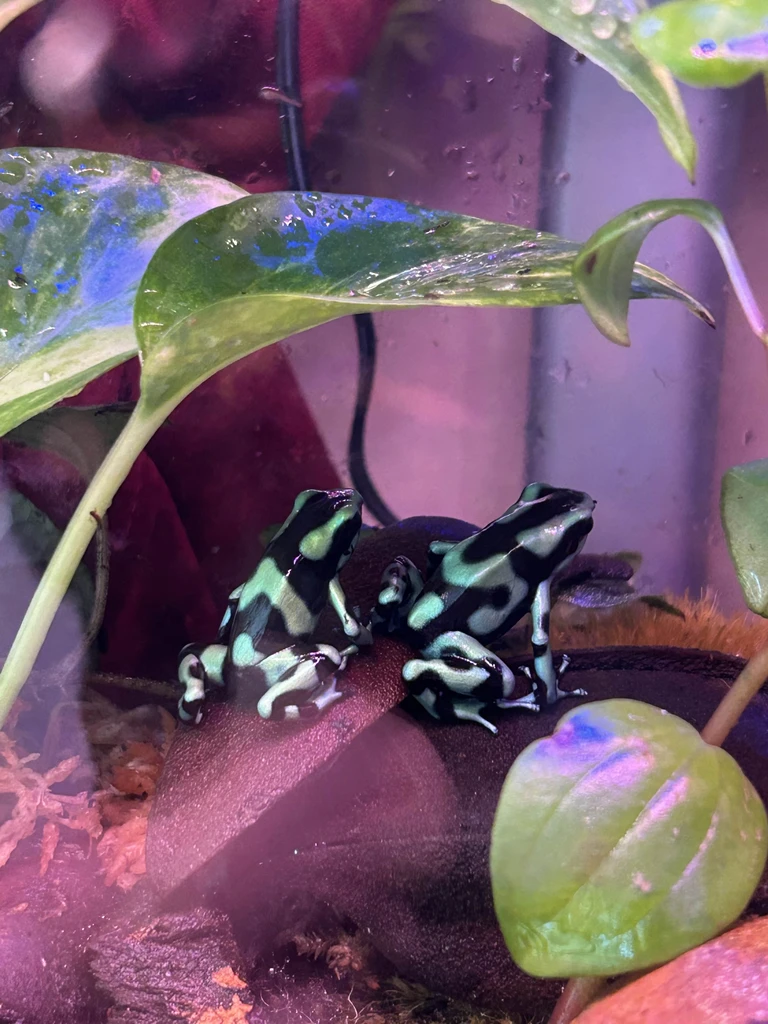
Dendrobates auratus — the green-and-black poison dart frog — is a small, bright, and startlingly active frog from the rainforests of Central America. It lives on the forest floor and in leaf litter, hunting tiny invertebrates during the day. It is diurnal, meaning it is active when you are, which makes it one of the more watchable frogs in the hobby. [Wikipedia; AMNH Amphibian Species of the World; IUCN 2020]
The "Nicaraguan green" name refers to a locality: captive lines whose ancestry traces to, or resembles, populations from southeastern Nicaragua, where the frogs tend to wear a vivid grass-green-and-black pattern. Nicaragua sits at the northernmost edge of this species' range. [Wikipedia; AMNH Amphibian Species of the World; IUCN 2020]
These frogs are tiny — adults are about 3.5–5 cm, roughly the length of your thumb. Males are slightly smaller; females are often wider across the body when mature. [Herpeton Academy]
The poison question (answer: not in captivity)
Yes, the name says "poison dart frog." Here is the honest answer:
Wild D. auratus are mildly to moderately toxic because they eat specific ants and mites that contain alkaloid compounds, which the frogs store in their skin. The toxicity is entirely dietary — it comes from what they eat in the wild, not from something the frog makes itself.
Captive-bred frogs raised on commercially available feeder insects — fruit flies, springtails, bean beetles — do not encounter those alkaloid sources. Research confirms that captive-bred D. auratus raised on standard feeder diets do not develop or maintain the alkaloid profile of wild frogs. [Daly, J.W., Myers, C.W., Whittaker, N. (1994). "Dietary source for skin alkaloids of poison frogs?" J Chemical Ecology 20(4):943–955. PMID 24242207. PMC article (National Aquarium study) also confirms captive-raised D. auratus "completely lacked alkaloids." Lakeforest.edu Eukaryon review cites Darst et al. 2005 (American Naturalist) to the same conclusion.]
In plain terms: captive-bred Nicaraguan green dart frogs are not dangerous to keep. They are still small, delicate amphibians that should be handled only when necessary — but they are not going to poison you.
Standard amphibian hygiene still applies. Like all reptiles and amphibians, dart frogs can carry Salmonella and other bacteria. Always wash your hands before and after any contact. Keep frogs away from your face. Children should handle under adult supervision only. [CDC Healthy Pets / Reptiles and Amphibians page, verified 2026-11-08; ARAV Salmonella in Reptiles and Amphibians guidance, verified 2026-11-08]
Wild range and status
In the wild, D. auratus lives in humid lowland and lower montane rainforest across southeastern Nicaragua, Costa Rica, Panama, and northwestern Colombia, from sea level to about 1,000 m elevation. It is found in dense leaf litter, on the roots of large trees, along stream banks, and in secondary growth. [Wikipedia; econaturalist.com; FWS Ecological Risk Screening Summary]
IUCN Red List status: Least Concern (2020 assessment). [IUCN SSC Amphibian Specialist Group, 2020. Dendrobates auratus. IUCN Red List: e.T55174A3024941. doi:10.2305/IUCN.UK.2020-2.RLTS.T55174A3024941.en. Status and decreasing population trend verified 2026-11-08 via Wikipedia footnote 1 citing IUCN 2020; AmphibiaWeb; conservationneeds.org.]
But the population trend is decreasing. The species is not endangered, but it is not stable either.
CITES: Appendix II. All poison dart frogs (family Dendrobatidae) are listed. This means export from range countries requires permits; all legal US specimens must be captive-bred. [Herpeton Academy, checked April 2026; Wikipedia CITES section, verified 2026-11-08]
Threats in the wild: the main driver of the decreasing trend is habitat loss — deforestation, agriculture, and urbanization shrinking and fragmenting the lowland rainforest. The pet trade historically moved large numbers internationally (approximately 62,000 specimens reported in cross-border trade between 1978 and 2008, per Carpenter et al. 2014 as cited in IUCN 2020 assessment — could not access Carpenter et al. original; this figure comes from a secondary source that cites IUCN 2020). Captive-breeding supply has reduced wild-harvest pressure in the US hobby. Chytrid fungus (Batrachochytrium dendrobatidis, Bd) has been detected in museum specimens and experimentally confirmed in captive D. auratus; chytrid-associated declines have been documented in parts of Panama. [b-aqua.com citing IUCN 2020 assessment sources including Crawford et al. 2010]
The species was introduced to Oahu, Hawaii in 1932 for mosquito control. The Hawaiian population is established and raises unanswered questions about its impact on endemic Hawaiian invertebrates. [FWS Ecological Risk Screening Summary; Wikipedia]
Did you know?
- This species was introduced to Oahu in 1932 on purpose — to control mosquitoes. It worked, sort of, but the frogs ended up eating other things too. [Wikipedia; FWS]
- Its bright colors are a warning to predators in the wild. In captivity, the message stays — the frog keeps its vivid colors — but the poison behind the warning is gone. [animaldiversity.org; Daly et al. 1994]
- D. auratus is diurnal — it hunts and lives during the day. Most small frogs in the hobby are nocturnal or crepuscular; this one is different, and you can actually watch it do its thing.
IUCN status verified: 2026-11-08. Review due: 2027-11-08.
Handling, Salmonella, and the never-release rule
This is not a handling species. Dart frogs are observation animals, not tactile pets. Handling stresses them. Their skin is permeable and sensitive — oils, lotions, and residues from human hands can be harmful to amphibians generally. [NSW Government amphibian hygiene guidance, 2026; Herpeton Academy]
If handling is necessary (vet examination, enclosure maintenance, or emergencies): use powder-free gloves moistened with clean dechlorinated water. Never pick up a dart frog with dry bare hands. Adult supervision is required for any child interaction. [NSW Government amphibian hygiene PDF, 2026]
Salmonella: like all reptiles and amphibians, D. auratus can carry Salmonella. Wash hands before and after any contact. Do not eat, drink, or touch your face while handling frogs or cleaning their enclosure. Keep frog equipment away from food preparation areas. [CDC Healthy Pets / Reptiles and Amphibians, verified 2026-11-08; ARAV Salmonella guidance, verified 2026-11-08]
The never-release rule: Never release a captive frog outdoors. Never dump vivarium water, substrate, or plant material into the garden, storm drain, or natural environment. Batrachochytrium dendrobatidis (Bd), the chytrid fungus responsible for mass amphibian die-offs worldwide, can be carried by captive frogs even when those frogs show no symptoms. This is not a minor preference — it is the most important biosecurity rule in amphibian keeping. See the Chytrid Hygiene section below for disposal guidance.
Keeper care guide
Nicaraguan green dart frog care guide
Researched: 2026-11-08 | Review due: 2027-11-08 | Vet review: The husbandry content in this guide has been reviewed.
This care guide is for educational and informational purposes only. It is not veterinary advice. Dendrobates auratus and all amphibians have individual health needs that may differ from general guidance. Husbandry science evolves; check the review date above.
This guide is based on research from keeper and scientific sources cited throughout (last checked: 2026-11-08). The husbandry content has been reviewed. Tevazirus recommends a wellness exam with an exotic-animal veterinarian experienced with amphibians for any frog in your care. Tevazirus does not endorse or take responsibility for the products, animals, or services of any third party mentioned or linked from this guide. If your animal shows signs of illness or distress, contact a veterinarian promptly.
0 Honest framing: this is an advanced pet
This section is upfront about difficulty. Dart frogs are among the more demanding keeper animals for three reasons: their feeder requirements are non-negotiable (live fruit flies and springtails, cultured yourself or bought regularly); their temperature tolerance is narrow (chronic overheating causes rapid decline); and their vivarium needs a working ecosystem — drainage, humidity, live plants, and hygiene — to stay safe for the frog.
If you are looking for your first frog, this is not it. If you are an experienced keeper who wants a diurnal, visually spectacular frog with a fascinating natural history and genuinely interesting captive behavior — this is a strong choice.
1 Vivarium setup
Minimum enclosure size: 45 × 45 × 45 cm (18" × 18" × 18") for a single frog or a pair. Larger is better. Floor area matters more than height for this terrestrial species, though some vertical structure is useful. Adding a second female requires more floor space. [Herpeton Academy; Feeling Froggy: "18×18×24 or 20-gallon long minimum for a pair"; Froglandia: "18"×18"×12" (floor-area-only minimum)"]
Construction: front-opening glass vivarium preferred. Fine-mesh screen sections needed for ventilation, but openings must be small enough to contain fruit flies — a common failure point is screen tops that allow flies to escape. Covering most of the screen with glass or a fitted panel keeps humidity in and prey items in. [theworldofrogs.weebly.com; keeper community consensus]
Vivarium style: D. auratus does not thrive in bare glass boxes. These frogs need structure — cork bark, leaf litter, root sections, plants. A naturalistic planted vivarium ("bioactive" style) is strongly recommended. The denser the cover at ground level, the more visible and active the frogs will be. [Herpeton Academy; Froglandia]
Substrate: ABG mix (Atlanta Botanical Garden substrate — orchid bark, long-fiber sphagnum moss, tree fern fiber, and charcoal) or a similar well-draining tropical substrate. A drainage layer or false bottom is essential to prevent saturation. Live plants — Philodendron, Epipremnum, ferns, bromeliads — regulate humidity and provide cover. Springtails and isopods as a cleanup crew are recommended. [Herpeton Academy; Feeling Froggy; Froglandia]
Leaf litter: magnolia, oak, or commercially available dried tropical leaves provide cover, support springtail populations, and create microhabitats the frogs actually use. [Froglandia; Herpeton Academy]
Sources: Herpeton Academy; Feeling Froggy; Froglandia; theworldofrogs.weebly.com.
2 Temperature
Daytime ambient: 22–26°C (72–79°F). [Herpeton Academy; Feeling Froggy; theworldofrogs.weebly.com]
Daytime peak (warm zone): around 26–27°C (79–81°F). [Herpeton Academy]
Night temperature: 20–22°C (68–72°F). [Herpeton Academy; Froglandia]
WARNING: Temperatures above 28°C (82°F) are dangerous. Chronic overheating causes rapid decline in this species. Most Georgia homes in summer will need active cooling or climate-controlled placement. This is a significant practical constraint for Georgia keepers.
Room-temperature keeping works well in many homes that maintain 68–78°F indoors. This species generally does not need a heat lamp or under-tank heater in a climate-controlled home — ambient room temperature is often sufficient, and adding heat increases the risk of overheating. [Froglandia; Herpeton Academy]
Sources: Herpeton Academy; Feeling Froggy; Froglandia; theworldofrogs.weebly.com.
3 Humidity
Target humidity: 80–100% relative humidity, measured at animal height. [Herpeton Academy; theworldofrogs.weebly.com; Feeling Froggy]
The upper end (near 100%) is a brief post-misting peak, not a sustained target. The vivarium should not become a sealed wet box — air exchange is as important as humidity. A daily misting cycle (once or twice daily with dechlorinated or reverse-osmosis water) maintains humidity while keeping airflow fresh. [Herpeton Academy]
Note on humidity range: Froglandia recommends 60–90% humidity with 70–80% as the "sweet spot" — lower than the 80–100% cited by most other keeper sources. This is a genuine range dispute. The majority of current keeper sources (Herpeton Academy, Feeling Froggy, theworldofrogs.weebly.com) cite 80–100%; guide standard uses 80–100%.
A drainage layer prevents substrate saturation. Waterlogged substrate smells sour, supports harmful bacteria, and stresses the frogs.
Sources: Herpeton Academy; Feeling Froggy; Froglandia; theworldofrogs.weebly.com.
4 Lighting
D. auratus is diurnal. A clear 10–12 hour day/night photoperiod is needed. [Herpeton Academy; theworldofrogs.weebly.com]
UVB lighting: this remains a genuinely disputed area in dart frog keeping.
Summary of positions:
- Specialist contra-UVB (dartfrog.pet): D. auratus actively prefers lower UV areas in field observations; D3 can be supplied via supplemented feeders. (Note: the specific field study cited by dartfrog.pet could not be independently verified; the behavioral preference observation is consistent with keeper experience but the citation is UNVERIFIED.)
- Low-level UVB cautiously (Herpeton Academy; theworldofrogs.weebly.com): Ferguson Zone 1 (UVI 0.5–1.0), low-output tube, with full shade retreat available.
- Supplement D3 instead (Froglandia): "There is debate; vitamin D can and should be supplied with powdered supplements."
Recommended default: supplement D3 via dusted feeders as the baseline. Low-level UVB can be added cautiously by more experienced keepers with a mandatory full-shade retreat — do not use UVB without ensuring the frogs can escape UV completely. Plant lighting (full-spectrum LED or T5 HO) for vivarium plants is separate from UVB and is widely used without controversy.
Sources: Herpeton Academy; Froglandia; Feeling Froggy; dartfrog.pet; theworldofrogs.weebly.com.
5 Feeding
Live prey only. Dart frogs will not eat dead, frozen, or artificial food items. [Froglandia; theworldofrogs.weebly.com]
Staple feeders:
- Drosophila melanogaster (small fruit fly): primary staple for most adults and all juveniles. [Herpeton Academy; Froglandia; Feeling Froggy]
- Drosophila hydei (larger fruit fly): variety option for larger adults. [Froglandia; Herpeton Academy]
- Springtails (Collembola): important secondary food and vivarium cleanup crew. [Herpeton Academy; Froglandia]
- Bean beetles: good variety feeder. [Herpeton Academy; Feeling Froggy]
Fruit fly cultures: maintaining live cultures continuously is a non-negotiable requirement. Cultures can be set up at home; one culture typically lasts 4–6 weeks before needing replacement. The keeper must always have at least 2–3 active cultures running in rotation. This is the single biggest barrier to entry for this species — not a minor inconvenience, but a real ongoing commitment.
Feeding frequency:
- Adults: 5–6 times per week in small portions. [Herpeton Academy]
- Juveniles: daily. [Froglandia; Herpeton Academy]
Supplementation: dust feeders with calcium and vitamin supplements before offering. Calcium with every feeding; vitamin D3 and other vitamins approximately twice a month (or per product instructions). Replace vitamin supplements every six months to avoid degradation. [Froglandia: "Calcium dust supplementation should be done with every feeding"; Feeling Froggy; theworldofrogs.weebly.com: "Vitamin and mineral supplements are essential, and should be replaced every six months."]
Use dechlorinated or reverse-osmosis water for misting and in any water features. Municipal tap water contains chlorine/chloramine that is harmful to amphibians' permeable skin. [Herpeton Academy]
Sources: Herpeton Academy; Froglandia; Feeling Froggy; theworldofrogs.weebly.com.
6 Captive-bred sourcing
All legal D. auratus in the US must be captive-bred. Wild collection for the US trade is not permitted; CITES Appendix II regulates exports at origin, and captive-bred supply is extensive. [Herpeton Academy; CITES appendices]
The captive-bred requirement is not just legal — it is welfare and conservation: wild-caught dart frogs carry higher parasite and pathogen loads and stress poorly in captivity; wild-harvest for rarer morphs puts pressure on localized populations; the captive-bred hobby lineage for D. auratus is long and well-established.
When sourcing, ask for documentation of captive-bred origin. Reputable breeders will provide it.
Sources: Herpeton Academy; CITES appendices.
7 Lifespan
Lifespan in captivity: plan for 10 years or more. Well-kept animals have been reported to live 15 years. Long-term captive lifespan data for this species is limited; the honest framing is to plan for a significant commitment with the understanding that individual outcomes vary. [ADW/Max Planck Institute: 8.3-year average captive lifespan (older data); Herpeton Academy: "around 10–15 years" with stable care; FWS ERSS: "longevity of at least six years reported in captivity" (Zimmermann & Zimmermann, 1994)]
Sources: Herpeton Academy; FWS Ecological Risk Screening Summary; ADW/Max Planck Institute.
8 Chytrid hygiene — the never-release rule
This section is non-negotiable.
Never release a captive dart frog outdoors. Never dump vivarium water, substrate, or plant material into the garden, storm drain, or natural environment.
Batrachochytrium dendrobatidis (Bd), the chytrid fungus responsible for mass amphibian die-offs worldwide, can be carried by captive frogs even when those frogs show no symptoms. Chytrid can survive in water for up to 7 weeks after frog contact. [Johnson, M.L. and Speare, R. (2003). "Survival of Batrachochytrium dendrobatidis in water." Emerging Infectious Diseases 9(8). wwwnc.cdc.gov/eid/article/9/8/03-0145_article.] Releasing a captive amphibian — or dumping contaminated water — into the environment can introduce Bd to wild populations.
Chytrid has contributed to the collapse of dozens of wild amphibian populations and the extinction of several species. The never-release rule is not a minor preference — it is the most important biosecurity rule in amphibian keeping.
If you need to dispose of vivarium water: heat to above 47°C (117°F) for 30 minutes, or treat with bleach (>1% concentration for 1 minute) before disposal. [AmphibiaWeb chytrid guidance; CDC Bd survival study; AmphibiaSurvivalAlliance]
Sources: Johnson & Speare (2003) CDC/EID; AmphibiaWeb; AmphibiaSurvivalAlliance.
9 Health and when to see a vet
Most common problems in captive D. auratus:
- Overheating — the single most common cause of rapid decline. Check temperature daily. [Herpeton Academy]
- Chronic stress from bare enclosures — frogs kept without adequate cover hide constantly and stop feeding. [Herpeton Academy]
- Red-leg syndrome (bacterial skin infection) — usually from poor water quality or saturated substrate. Signs: reddening of belly or feet, lethargy, loss of appetite. Requires vet treatment. [Herpeton Academy; NSW Government amphibian hygiene guidance]
- Insufficient supplementation — leads to metabolic bone disease and other nutritional deficiencies. Calcium and vitamin D3 must be supplemented in feeder dusting. [Froglandia; theworldofrogs.weebly.com]
- Chytrid infection — quarantine all new frogs for at least 60 days before joining an established collection. Any frog with persistent weight loss, skin lesions, swelling, or prolonged refusal to feed should be seen by a vet experienced with amphibians. [AmphibiaWeb; NSW Government; Young et al. 2007 quarantine recommendation]
When to see a vet:
- Any significant weight loss combined with lethargy
- Red or irritated feet and belly not resolving quickly
- Persistent refusal to feed beyond 1–2 weeks without clear environmental cause
- Swelling anywhere on the body
- Abnormal posture or movement
- Any frog that seems "off" and stays that way
Finding an amphibian vet: ARAV (arav.org) has a vet locator. In Georgia, the University of Georgia College of Veterinary Medicine (UGA CVM) has an exotic animal service.
Sources: Herpeton Academy; Froglandia; AmphibiaWeb; NSW Government; theworldofrogs.weebly.com.
10 Georgia legal status
Dendrobates auratus does not appear on Georgia DNR's restricted or prohibited exotic species list as of 2026-11-08.
Verified 2026-11-08: gadnrle.org/exotics lists prohibited amphibians as "Giant and Marine toads" only. Dendrobatidae are not listed. gadnrle.org/legal-pets does not list dart frogs as prohibited native wildlife. [gadnrle.org/exotics, accessed 2026-11-08; gadnrle.org/legal-pets, accessed 2026-11-08]
However: GA DNR's exotics page states explicitly that the list is "not all-inclusive" and that "The Department should be consulted before any exotic animals which are not normally domesticated in Georgia are acquired." Georgia law defines "wild animal" broadly — any animal not normally a domestic species in the state. Dart frogs are non-native wild animals and are not "normally domesticated."
The correct legal note: Dendrobates auratus does not appear on Georgia DNR's restricted or prohibited exotics list as of the date checked. Because the list is explicitly not all-inclusive and dart frogs are non-native wild animals, verify current legal status with Georgia DNR before acquiring. Contact: GA DNR Special Permit Unit, 770-918-6408.
CITES note: all legal US specimens must be captive-bred. Interstate transport of captive-bred specimens is standard hobby practice with CITES Appendix II documentation requirements. Confirm CB documentation with any source.
Sources: gadnrle.org/exotics, accessed 2026-11-08; gadnrle.org/legal-pets, accessed 2026-11-08; Georgia DNR Special Permit Unit.
Sources and citations
- Tier A — Scientific / Government
- IUCN SSC Amphibian Specialist Group, 2020. Dendrobates auratus. IUCN Red List: e.T55174A3024941. doi:10.2305/IUCN.UK.2020-2.RLTS.T55174A3024941.en. Status and decreasing population trend verified 2026-11-08 via Wikipedia/IUCN 2020, AmphibiaWeb.
- Daly, J.W., Myers, C.W., Whittaker, N. (1994). "Dietary source for skin alkaloids of poison frogs?" J Chemical Ecology 20(4):943–955. PMID 24242207.
- Johnson, M.L. and Speare, R. (2003). "Survival of Batrachochytrium dendrobatidis in water." Emerging Infectious Diseases 9(8). CDC/EID.
- CDC, "Reptiles and Amphibians." cdc.gov/healthy-pets/about/reptiles-and-amphibians.html. Last updated Jan 13, 2026. Verified 2026-11-08.
- ARAV Salmonella in Reptiles and Amphibians guidance. arav.org. Verified 2026-11-08.
- FWS Ecological Risk Screening Summary: Dendrobates auratus.
- NSW Government: Amphibian hygiene guidance PDF, 2026.
- gadnrle.org/exotics, accessed 2026-11-08; gadnrle.org/legal-pets, accessed 2026-11-08.
- Tier B — Reputable keeper community
- Herpeton Academy: Dendrobates auratus care guide. academy.herpeton.net.
- Froglandia: dart frog care guide. froglandia.com.
- Feeling Froggy: D. auratus care. feelingfroggy.net.
- theworldofrogs.weebly.com: dart frog care guide.
- AmphibiaWeb: species 1625 (D. auratus). amphibiaweb.org.
- AmphibiaSurvivalAlliance: chytrid biosecurity protocols.