
Keeper care guide · species ID at high confidence
Florida ivory millipede
Chicobolus spinigerus — identified from photographs at high confidenceSpecies identification: high confidence, not formally confirmed
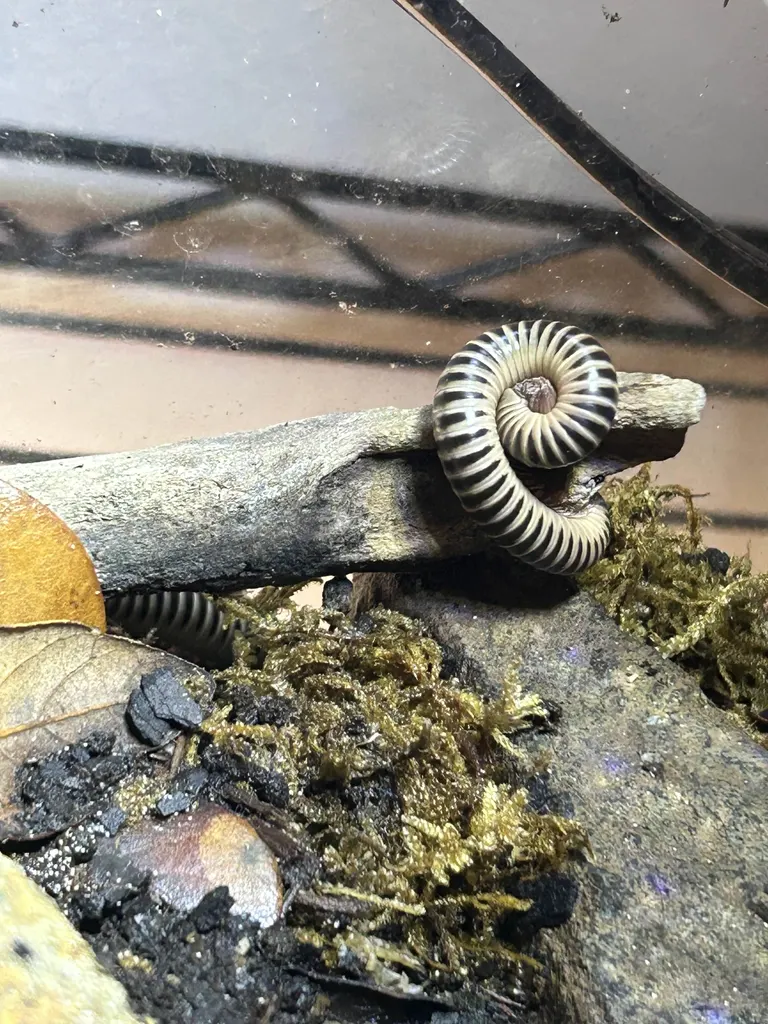
This animal was identified from photographs as Chicobolus spinigerus (Florida ivory millipede, Black & White Ivory locale) at high confidence. The ID is based on the black-and-cream circumferential banding, juliform cylindrical body, smooth glossy cuticle, tight defensive coiling, and the animal's US-breeder sourcing — which makes Chicobolus spinigerus, a monotypic genus native to the southeastern United States, by far the most parsimonious explanation. [iNaturalist taxon 81543; The Defiant Forest; PostPods.co.uk]
The identification has not been confirmed by physical examination under magnification (the taxonomic gold standard for this group is gonopod examination). If you need species-level certainty for formal documentation or research, gonopod examination is the standard method.
The care guidance in this page is specific to Chicobolus spinigerus and is based on that identification at high confidence.
About this species
What kind of animal is a Florida ivory millipede?
The Florida ivory millipede is an arthropod — related to insects and crustaceans, but its own separate class. Its scientific name is Chicobolus spinigerus. The genus contains only this one species. [Tier B: iNaturalist taxon 81543; MilliBase — World Register of Marine Species]
Millipedes belong to the class Diplopoda. Their name means "thousand feet," and while no millipede actually reaches a thousand, most have somewhere between 40 and 200 legs arranged in pairs along a segmented body — two pairs per segment. Watch one move and a slow wave ripples down the length of its legs from back to front.
Florida ivory millipedes are detritivores. Their whole role in nature is eating dead and decaying plant matter — fallen leaves, rotting wood, decomposing bark. They are the forest floor's composting crew. Their waste (frass) returns nutrients to the soil. [Tier B: PostPods.co.uk care guide; The Defiant Forest care guide]
They do not hunt, sting, or bite. When threatened, a Florida ivory curls into a tight spiral — head tucked inside, hard outer shell facing out. That coil is their primary defense, and it is completely normal behavior. See the handling section for the one real safety note.
Native range and wild status
The Florida ivory millipede is native to the southeastern United States — the Florida Peninsula and panhandle, as well as southern Alabama, Georgia, and South Carolina. [Tier B with taxonomy support: iNaturalist taxon 81543, citing Keeton 1960 Memoirs of the American Entomological Society; iNaturalist guide "Beneficial Garden Bugs of the SC Lowcountry"; Encyclopedia of Life (EOL) geographic distribution data citing Memoirs of the AES]
If the identification is correct, this is a species native to the southeastern United States, including Georgia — the same millipede found in local forests.
IUCN Red List status: Not Evaluated. Millipede species are almost entirely unevaluated on the global Red List — not because they are not worth protecting, but because the science has not yet caught up. No IUCN assessment exists for Chicobolus spinigerus specifically. [Source: iNaturalist taxon 81543; MilliBase record]
CITES: Not listed. No CITES Appendix coverage for this species or genus.
Why native species matters to keepers: Never release captive animals into the wild. Even native-range species can carry pathogens from other animals they have shared space with. A released captive can introduce disease into a wild population. Do not collect from wild populations. The captive-bred hobby for this species is well-established in the United States, with multiple breeders producing stock. Wild-collecting is considered bad practice in the keeper community and may be subject to local regulations — verify with the Georgia DNR if you have questions.
Georgia legal status
Chicobolus spinigerus was not found on Georgia's list of regulated or restricted animals (Georgia DNR wild animal rules, georgiawildlife.com/wild-animal-rules, confirmed 2026-11-08; gadnrle.org/legal-pets, confirmed 2026-11-08). Georgia's wildlife regulations focus on specific reptiles, amphibians, and large exotic mammals. This information is provided as a starting point only — verify current requirements directly with the Georgia Department of Natural Resources (Wildlife Resources Division) before acquiring or selling any animal. Phone: 770-918-6408.
Defensive secretion and handling safety
When a millipede feels threatened, it may release a defensive secretion through pores along its body. This secretion contains benzoquinones and other chemicals. Contact with this secretion can cause skin irritation, intense burning or itching, blistering, and brown staining of the skin (may persist for months). If it reaches the eyes: conjunctivitis, inflammation of the cornea, pain, tearing, spasm of eyelids, and in rare cases more serious effects including blindness. [Tier A: MedlinePlus "Millipede toxin," medlineplus.gov/ency/article/002846.htm — National Library of Medicine, reviewed 10/14/2025, by Jesse Borke MD FAAEM FACEP et al.]
Safety rules — read before handling:
- Always wash hands thoroughly with soap and water before and after handling.
- Keep hands away from your face while handling.
- Never touch your eyes after handling.
- Children must have an adult present at all times when handling a millipede.
- If secretion contacts skin: wash the exposed area thoroughly with soap and water immediately. Do not use alcohol on the area. [Tier A: MedlinePlus]
- If secretion reaches eyes: rinse eyes immediately with water for at least 20 minutes. Seek medical attention right away. Do not wait to see if it improves. [Tier A: MedlinePlus]
- Poison Control: 1-800-222-1222 (US, free, 24/7) [Tier A: MedlinePlus]
The secretion is a real concern, not a reason to avoid this species — it is easily managed with the above precautions and does not occur during calm, undisturbed handling.
Note on salmonella: millipedes are invertebrates, not reptiles or amphibians. No peer-reviewed study on salmonella carriage in pet millipedes was found in this research. Standard hygiene — handwashing before and after, avoid face-touching, keep the enclosure clean — is good practice for any animal.
Keeper care guide
Florida ivory millipede care guide
Researched: 2026-11-08 | Review due: 2027-11-08
This care guide is for educational purposes only. It is not veterinary advice. Invertebrate husbandry is a specialist area with limited formal research. This guide does not require veterinary review before serving as general keeper information, but the claims flagged below (heat mat rule, lifespan estimate) have not been independently confirmed by an invertebrate veterinarian.
This care guide is for educational purposes only. It is not veterinary advice and does not substitute for a consultation with a licensed veterinarian. The heat mat claim in this guide is based on keeper-community consensus (Tier B) and has not been confirmed by a formal veterinary source — treat it as best current practice, not a clinical instruction. Researched: 2026-11-08. Review due: 2027-11-08. Tevazirus recommends consulting an exotic animal veterinarian for any health concerns with your animal.
1 Enclosure
A minimum floor area of 40 × 30 cm (roughly 16 × 12 inches) is a workable starting point for a small group of two to five animals, with an enclosure height of 30 cm minimum to allow adequate substrate depth and a little space above. [Tier B: Keepr.pet husbandry guide; atlarium.bio species sheet]
Front-opening enclosures or those with a mesh panel in the lid or side are preferred. Good cross-ventilation is essential to prevent mold — stagnant air in a humid enclosure will cause substrate problems that harm the animal. [Tier B: BugzUK product/care page: "must have cross ventilation to avoid any mould build up"]
Florida ivory millipedes are not strong climbers by millipede standards, but they will move off the substrate surface and may use cork bark for shelter and enrichment. [Tier B: BugzUK care page; PostPods.co.uk care guide]
Sources: Keepr.pet; atlarium.bio; BugzUK; PostPods.co.uk.
2 Substrate — the most important element
Substrate depth is the foundation of this animal's care.
Minimum depth: 10 cm (4 inches). If you want your animals to breed, aim for 15 cm or more.
The reason depth matters is molting (see Molting section below). An ivory millipede needs enough depth to excavate its own underground chamber and lie immobile there for days or weeks. Shallow substrate means no chamber; a failed molt is usually a dead millipede. [Tier B: PostPods.co.uk care guide (cites Keeton 1960); Red Rocks Exotic Reptiles care guide v2.0]
Substrate mix — combine the following:
- The majority should be decaying hardwood and leaf litter worked through a topsoil or coconut fibre base
- Some soft white-rotted hardwood that crumbles easily
- A small amount of play-pit sand or bird grit (not builders' sand)
- A small amount of crushed cuttlebone or food-grade limestone powder (calcium source)
Never use:
- Pine or cedar wood or bark — these contain compounds that harm invertebrates
- Soil, wood, or leaves treated with pesticides, herbicides, or fertilizers — this is the primary husbandry-related mortality cause reported in keeper communities
- Commercially composted soil unless you can confirm it is pesticide-free
[Tier B: BugzUK substrate recipe; PostPods.co.uk care guide; The Defiant Forest care guide]
Moisture: Keep the lower substrate consistently moist. The surface can be allowed to dry slightly between misters — a moisture gradient (moist below, drier above) gives the animal choice. The practical test: squeeze a handful of substrate at mid-depth — it should clump together but not drip. Never flood the enclosure. [Tier B: PostPods.co.uk care guide; Red Rocks Exotic Reptiles care guide v2.0; atlarium.bio]
Do not use a deep open water dish — it is unnecessary (the animal hydrates from moist substrate and food) and small offspring can drown. If you use a dish, keep it very shallow. [Tier B: Red Rocks Exotic Reptiles care guide v2.0; atlarium.bio]
Sources: BugzUK; PostPods.co.uk; The Defiant Forest; Red Rocks Exotic Reptiles care guide v2.0; atlarium.bio.
3 Temperature
Florida ivory millipedes are subtropical, not tropical. This distinction matters for heating decisions.
Comfortable range: 21–26°C (70–79°F) ambient. [Sources and their ranges: PostPods.co.uk (citing Keeton 1960 range data): 21–26°C; "around 21°C fine, simply less active"; The Defiant Forest care guide: 70–80°F (21–27°C); Red Rocks Exotic Reptiles care guide v2.0 (Oct 2026): 70–78°F (21–26°C); BugzUK: 22–24°C; Keepr.pet: 22–27°C]
The range 21–26°C is consistent across all sources. PostPods.co.uk notes that the claim of rapid death below 21°C "traces back to a single keeper report the source itself hedges" and cannot be squared with the natural range extending into Georgia and South Carolina, where winter nights are cold. Use the full range, not just the top of it.
Heat mats: Do not use a heat mat under the substrate. Under-tank heating dries out the deep layer where the animal molts, which is the most vulnerable point in its life cycle. If the room temperature is too cool, stabilizing the room temperature is the preferred solution. If a heat source is needed, place it on one side of the enclosure (never underneath) on a thermostat. [Tier B: BugzUK; PostPods.co.uk; Red Rocks Exotic Reptiles care guide; atlarium.bio — Tier B consensus. No Tier A veterinary source for this specific claim was found in this research. Vet review recommended before publication as a formal instruction.]
Sources: PostPods.co.uk; The Defiant Forest; Red Rocks Exotic Reptiles; BugzUK; Keepr.pet; atlarium.bio.
4 Humidity
Comfortable range: 65–85% relative humidity. [Sources: The Defiant Forest care guide: 65–85%; PostPods.co.uk: 70%+ in practice; "good substrate moisture is more important than air humidity reading"; BugzUK: 70–80%; Keepr.pet: 70–85%; atlarium.bio: 70–85%]
Humidity comes primarily from the moist substrate and misting, not from an enclosed, stagnant environment. Cross-ventilation is required (see Enclosure). Measuring air humidity alone does not tell you whether buried animals have access to moisture — checking substrate moisture below the surface is what matters. [Tier B: Red Rocks Exotic Reptiles care guide v2.0; PostPods.co.uk]
Sources: The Defiant Forest; PostPods.co.uk; BugzUK; Keepr.pet; atlarium.bio; Red Rocks Exotic Reptiles.
5 Diet
Florida ivory millipedes are detritivores. The substrate is their primary food source — they eat the decaying leaves and rotting wood it is made from. Replenish decomposing material as it is consumed.
Supplemental food: soft fruits and vegetables are accepted — cucumber, courgette (zucchini), melon, apple, leafy greens. Offer small portions and remove uneaten food promptly to prevent mold.
Calcium source: always available. Leave a piece of crushed cuttlebone or a pinch of food-grade limestone powder in the enclosure at all times. Calcium is essential for the exoskeleton, especially during and after molting.
[Tier B: BugzUK; The Defiant Forest care guide; PostPods.co.uk; Keepr.pet]
Sources: BugzUK; The Defiant Forest; PostPods.co.uk; Keepr.pet.
6 Molting — the most critical period
Molting is the most critical period in this animal's life cycle. Florida ivory millipedes molt underground. The animal excavates a chamber in the substrate, seals it, and lies completely immobile while it sheds its exoskeleton and slowly re-hardens. This can last days to weeks.
The most important rule in this guide: never disturb a buried animal. If your millipede has been underground for days or weeks, it is likely molting. Digging it out — even to check on it — can interrupt the molt and kill it. Deaths from post-molt handling are documented across keeper communities. [Tier B: PostPods.co.uk care guide (cites Keeton 1960 for the anatomy); Red Rocks Exotic Reptiles care guide v2.0; The Defiant Forest care guide]
Coiling on the surface is also not distress — it is normal defensive behavior. Do not attempt to uncoil the animal.
Juveniles emerge from the egg with only three pairs of legs and add segments and legs at each molt, so a young animal looks very different from an adult. [Tier B: PostPods.co.uk care guide]
Do not perform a deep full substrate change while animals may be molting underground. If the substrate must be changed, plan carefully to preserve moist chambers. [Tier B: Red Rocks Exotic Reptiles care guide v2.0]
Sources: PostPods.co.uk; Red Rocks Exotic Reptiles; The Defiant Forest.
7 Lifespan
Keeper estimates for Chicobolus spinigerus in captivity are approximately 5–7 years. This is a keeper estimate based on captive experience, not a measured statistical average from a formal study. [Tier B: Red Rocks Exotic Reptiles care guide v2.0 (explicitly labeled "planning estimate, not a measured statistical average"); Keepr.pet husbandry guide; BugGuide.net notes "one of the fastest-growing millipedes, can reach adulthood in about 18 months"]
Sources: Red Rocks Exotic Reptiles; Keepr.pet; BugGuide.net.
8 Handling and kid safety
Florida ivory millipedes are docile and slow-moving. They do not bite. They can be handled gently, with an adult present, over a flat soft surface — if a millipede falls from a height it can be injured.
See the Safety panel above for the defensive secretion guidance. This is the primary safety concern for all ages.
Always wash hands before and after handling. Keep hands away from face. Never touch eyes after handling.
9 Breeding
Florida ivory millipedes breed readily in captivity when housing and substrate are correct. Mixed-sex groups will reproduce. Clutch sizes of roughly 60–100 eggs per clutch are reported in keeper communities; the higher figures should be treated with some caution. [Tier B: PostPods.co.uk care guide]
Juveniles require the same substrate as adults — the microbes in the decaying substrate are critical for their development. Do not separate juveniles into a different setup.
Cohabitation note:
- Springtails: compatible without reservation. Add them freely.
- Isopods: disputed. Fast-breeding, protein-hungry Porcellio species and powder isopods are implicated in nibbling freshly molted individuals and taking eggs and hatchlings. Dwarf white isopods are described as lower risk. If actively breeding, springtails only is the cautious approach. If you use isopods, keep density low and keep them well fed. [Tier B: PostPods.co.uk care guide]
Sources: PostPods.co.uk.
10 Vet care
Invertebrate veterinary care is a specialist area. No routine veterinary review is required for general keeper husbandry of this species. If your millipede shows persistent inactivity outside a normal molt cycle, stops eating for an extended period after expected molt recovery, or shows unusual behavior, consult an exotic animal veterinarian experienced with invertebrates. The ARAV directory (arav.org) is a starting point for finding a vet.
Sources and citations
- Tier A — Medical / Government
- MedlinePlus, "Millipede toxin," medlineplus.gov/ency/article/002846.htm — National Library of Medicine. Review date 10/14/2025, by Jesse Borke MD FAAEM FACEP et al. Confirmed accessible 2026-11-08.
- Georgia DNR, "Rules Pertaining to Wild Animals": georgiawildlife.com/wild-animal-rules — confirmed 2026-11-08.
- Georgia DNR, "Guide to Legal Pets": gadnrle.org/legal-pets — confirmed 2026-11-08.
- Tier B — Taxonomy / Natural history / Keeper community
- iNaturalist taxon 81543 (Chicobolus spinigerus): inaturalist.org/taxa/81543-Chicobolus-spinigerus — cites Keeton 1960 (Memoirs of the American Entomological Society) and Hoffman 1999. Confirmed 2026-11-08.
- Encyclopedia of Life (EOL), Chicobolus spinigerus: eol.org/pages/310286 — confirmed 2026-11-08.
- BugGuide.net, Species Chicobolus spinigerus: bugguide.net/node/view/42568 — confirmed 2026-11-08.
- The Defiant Forest (US breeder), Ivory Millipede species & care guide: thedefiantforest.com — published 2026-03-25. Confirmed 2026-11-08.
- PostPods.co.uk, Ivory Millipede Care Guide: postpods.co.uk — author: Daniel Brown; published 2026-08-10. Confirmed 2026-11-08.
- BugzUK, Chicobolus spinigerus product/care page: bugzuk.com — confirmed 2026-11-08.
- Red Rocks Exotic Reptiles (RRE), Ivory Millipede Care Guide v2.0 (Oct 2026): rrereptiles.com/care-guides/ivory-millipede.html — confirmed 2026-11-08.
- Keepr.pet, Chicobolus spinigerus husbandry guide: keepr.pet/husbandry/en/chicobolus-spinigerus — confirmed 2026-11-08.
- Atlarium.bio, Florida ivory millipede: atlarium.bio/en/catalog/terrestrial-invertebrates/chicobolus-spinigerus — confirmed 2026-11-08.