
Keeper care guide
Orange Cream & Powder Blue Isopods
Porcellionides pruinosusPhoto: Porcellionides pruinosus (Brandt, 1833) / Alex Abair / CC BY 4.0 via iNaturalist — wild specimen, France
About this species
What kind of animal is an isopod?
Isopods are crustaceans — which puts them in the same group as crabs and shrimp, not insects. The species kept in the hobby is Porcellionides pruinosus. You might know its cousins as roly-polies, pill bugs, or woodlice.
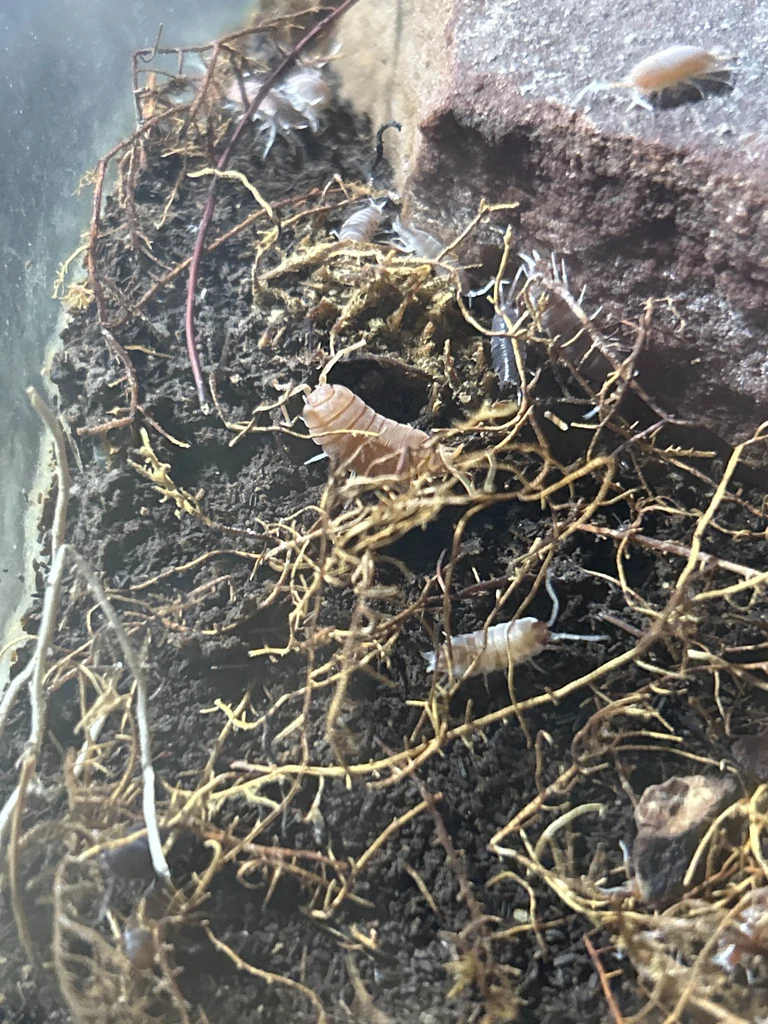
The Orange Cream and Powder Blue morphs are both the same parent species, Porcellionides pruinosus. They are captive-bred colour forms — hobby trade names for different patterns that breeders have developed over generations of selective keeping. Orange Cream shows a warm creamy-orange dorsal wash with pale cream edges. Powder Blue has a solid grey-blue powdery colour across the whole body. Neither morph exists in the wild.
The wild ancestor of both comes from the Mediterranean — dry grasslands, scrublands, and forest edges across southern Europe, where they live under bark, fallen leaves, and stones. They have since spread worldwide through the plant and pet trade.
Isopods breathe through gill-like structures called pleopods on their underside. This is why they need at least some humidity to survive — not soaking wet, but never fully dry.
Wild range and status
Parent species: Porcellionides pruinosus (Brandt, 1833). Wild origin: Mediterranean basin — southern Europe, North Africa, and surrounding temperate regions. Now cosmopolitan through human-mediated spread.
IUCN Red List status: Not Evaluated (NE). What "Not Evaluated" means: it does not mean the species is endangered and was overlooked. It means the IUCN has not yet assessed this species against its criteria. Not Evaluated is not the same as Least Concern, and it is not the same as a threat. For a fast-breeding, cosmopolitan species that has spread across five continents with the help of human trade, lack of assessment reflects a research-priority gap, not hidden conservation concern. "Not Evaluated" is the honest framing — not a guarantee of security, and not a conservation concern in this context.
CITES: Not listed. No federal or Georgia state permit required to keep.
Status verification date: 2026-10-28 and 2026-10-29. Review due: 2027-10-29.
Did you know?
- Isopods are nature's cleanup crew. They eat dead leaves, rotting wood, and decaying plant material. As they feed, they break it down into smaller pieces that soil bacteria and fungi can finish decomposing — that process is how nutrients get recycled back into soil.
- Isopods can remove heavy metals from soil. As they eat organic matter in contaminated soil, they absorb copper, zinc, lead, and other metals into their bodies, crystallizing them in a way that makes the metal less harmful to the surrounding environment.
- A female isopod carries her eggs in a built-in brood pouch on her underside — called a marsupium, the same word used for kangaroo pouches. The babies hatch and live inside the pouch until they are ready to emerge as miniature adults.
- Isopods moult their exoskeleton in two stages — back half first, then front half a day or two later. You may see an isopod that looks half-coloured during this process. That is normal.
Conservation status framing
These isopods are Not Evaluated by the IUCN — not because they are endangered, but because their status has not been formally assessed. They are cosmopolitan, fast-breeding, and entirely captive-bred in the hobby trade. There is no conservation concern attached to the Orange Cream or Powder Blue morph or to the parent species in the context of the pet trade.
The conservation angle for this species is responsibility in the other direction: keeping non-native animals contained, not releasing them outdoors, and maintaining good colony health so animals do not suffer from neglect.
Hygiene and handling
Isopods are invertebrates — they are not reptiles or amphibians. The specific Salmonella risk associated with reptiles and amphibians does not apply to isopods. The primary hygiene concern with isopods in captivity is general invertebrate hygiene: the substrate they live in is moist organic matter, which can harbour bacteria and mould.
- Wash your hands with soap and water before and after handling or doing enclosure maintenance.
- Adult supervision for children is recommended during enclosure maintenance and substrate work, as organic substrate can contain mould spores that may be irritating if inhaled.
- Ventilate the room when doing major substrate changes.
Keeper care guide
Isopod care guide — Orange Cream and Powder Blue
Researched: 2026-10-29 | Review due: 2027-10-29 | Vet review: Not required for invertebrate care of this type; hygiene claim independently verified by Rook 2026-10-30.
Both morphs share the same care needs. Any morph-specific notes are called out inline. This guide covers a standalone culture colony or a bioactive vivarium cleanup crew role.
0 Quick-reference card
| Parameter | Range | Notes |
|---|---|---|
| Temperature | 70–82°F (21–28°C) | 72–78°F is the sweet spot |
| Humidity (overall) | 50–75% | Need a moisture gradient, not uniform wet |
| Moist retreat zone | Always present | One corner kept reliably damp |
| Substrate depth | 2–4 inches (5–10 cm) | Deeper is better; they live in it |
| Calcium source | Always available | Cuttlebone, crushed eggshell |
| Ventilation | Cross-ventilation required | Sealed bin = crashed culture |
| Primary food | Leaf litter + rotting hardwood | Must always be available |
| Supplemental food | Veg scraps + protein | 1–2× per week |
| Lifespan | Approximately 2–3 years | Individual; colonies run indefinitely |
1 What they need and why
Isopods are detritivores — they eat dead and decaying organic material. In the wild they live under bark and leaf litter in a world of consistent, moderate humidity. Their biology follows that origin: they need a moist retreat but can handle a drier zone too, as long as they can choose.
The most common reasons a colony crashes: sealed bin (no airflow), dried out, too hot for too long, no calcium. Get those four things right and P. pruinosus is one of the most forgiving invertebrates to keep.
Sources: tcinsects.com; postpods.co.uk; multiple keeper care guides (Tier B).
2 Enclosure
Any ventilated container works: a plastic shoebox, a small glass terrarium, or a bioactive vivarium. Size to the colony — a starter group of 10–25 isopods does fine in a 3–6 quart plastic tub. A growing colony of 100+ benefits from more room.
Ventilation is not optional. Punch or drill ventilation holes on at least two sides of the container. Cross-ventilation (holes on opposing sides) works better than holes only on top. Without airflow, moisture stagnates, mould blooms, and mite populations can explode. A fine mesh over the holes prevents escapes — these animals are fast and small.
Escape note: P. pruinosus are active and quick. Check lid seals regularly and ensure no gaps around ventilation mesh.
Sources: iheartbugs.com; tcinsects.com; leaflitterlab.com (Tier B).
3 Substrate
Depth: 2–4 inches (5–10 cm). Isopods eat their substrate as well as live in it. Organic material is essential; inert substrates like plain sand provide nothing.
A workable base mix: organic topsoil (no added fertilizers, pesticides, or perlite) blended with coconut coir for moisture retention, and decomposed or white-rotted hardwood for food value. Top with a thick layer of leaf litter. Replace leaf litter as it gets consumed — oak and magnolia leaves are particularly good.
What to avoid: soil with added fertilizers or perlite (both can stress or kill isopods); cedar or pine wood and leaves (contain compounds harmful to invertebrates); any substrate treated with pesticides.
Calcium must be available in the substrate or as a supplement. Without calcium, exoskeleton development fails at each moult. Add a piece of cuttlebone, a small pile of crushed eggshell, or crushed oyster shell to the enclosure permanently. Replace when consumed.
Sources: thebiodude.com; iheartbugs.com; leaflitterlab.com; allanglescreatures.com; tcinsects.com (Tier B). Substrate depth per leaflitterlab.com / Leaf Litter Lab isopod guide (Tier A for soil ecology).
4 Moisture gradient and humidity
This is the most important parameter for P. pruinosus. Keep one end or corner of the enclosure reliably moist (damp sphagnum moss or wet substrate, not waterlogged). The other end can be drier. The isopods will settle where they need to be. This gradient matters more than maintaining any single overall humidity percentage.
Overall humidity target: 50–75%. P. pruinosus is more tolerant of drier conditions than many isopod species, but their humid retreat must always be there. Without access to humidity they dry out and die. They need moisture to breathe (through their gill-like structures) and to moult successfully.
Moisture gradient setup: add water to the moist corner every few days, or mist that corner only. Let the other side dry out slightly between waterings. Check daily for the first week until you understand your setup's drying rate.
Temperature range: 70–82°F (21–28°C). A comfortable household temperature works fine. Reproduction slows below 65°F. Colony stress increases above 85°F without strong ventilation. They do not need supplemental heating in most Georgia homes, but avoid placing the enclosure in a cold draft or near a heat vent.
Sources: tcinsects.com; postpods.co.uk; thebiodude.com; terrariumtribe.com; Minibeast Wildlife AU; EBSCO / Isopoda (Tier A for gill-moisture biology).
5 Diet
Primary diet — always available:
- Leaf litter (oak, magnolia, sea grape preferred; avoid pine, cedar, any treated wood)
- Rotting hardwood (pieces of white-rotted oak, birch, or other hardwood logs)
- Cork bark (doubles as food and as hide structure)
Supplemental food — 1–2 times per week, small amounts:
- Vegetables: zucchini, cucumber, carrot, sweet potato, squash. Remove uneaten pieces after 24–48 hours to prevent mould.
- Protein: a pinch of fish flakes, dried shrimp, or insect-based food. A small amount once a week is enough. Protein supports breeding. More than a small amount can tip the enclosure toward mould and bacterial blooms.
Calcium — always available: cuttlebone piece, crushed eggshell, or crushed oyster shell. This is diet and supplement in one. The isopods eat it as needed.
Sources: thebiodude.com; iheartbugs.com; leaflitterlab.com; terrariumtribe.com; bioactivebugs.co.uk (Tier B, consistent across all sources).
6 Breeding basics
P. pruinosus is one of the fastest-breeding isopod species in the hobby. Once conditions are right, a colony expands rapidly without any special intervention.
Females carry their eggs in a brood pouch (marsupium) on the underside of the body. After 3–5 weeks, the eggs hatch and the babies (called mancae) emerge as miniature adults, ready to eat and move around. Under good conditions, a female can produce a new brood roughly every 4–8 weeks.
Moulting: isopods moult their exoskeleton in two stages — back half first, front half 1–2 days later. A moulting isopod looks split in colour. Do not disturb them during the moult. They eat their shed exoskeleton, which is normal and recycles the calcium.
Sources: VWR Land Isopods PDF (Tier A); encyclopedia.com Isopoda; furrycritter.com; postpods.co.uk.
7 Responsible keeping — never release non-native isopods outdoors
P. pruinosus is native to the Mediterranean region and has already spread worldwide through human movement. In the US, it is established in some regions but is not native to Georgia. Releasing non-native isopods outdoors — including into an outdoor compost bin — can disrupt native isopod populations, alter local soil ecology, and introduce pathogens to native invertebrate communities.
If you can no longer keep your colony: rehome to another keeper, donate to a school or nature education program, or contact the source vendor. Do not release. This applies to accidental escapes too — secure enclosure lids and ventilation mesh.
Source: iere.org responsible isopod release guide (Tier B ecology); keeper care PDF sources consistent across all reviewed.
8 Isopods as vivarium cleanup crew
Both morphs are commonly used as bioactive cleanup crew alongside springtails in tropical and temperate vivariums. In this role they process waste, eat uneaten feeder insects, and help prevent mould in substrate. P. pruinosus is noted for being faster-moving and more active than many isopod species, which makes it effective as cleanup crew but also means it needs good ventilation in enclosed vivariums.
If keeping as vivarium cleanup crew, confirm the host vivarium temperature is within their tolerance range (70–82°F) — setups running at 85°F+ consistently may stress the colony.
Sources: cucarachaplug.com; thebiodude.com; tcinsects.com (Tier B).
Sources and citations
- Tier A — Scientific / University Extension / Government
- IUCN Red List categories — NE definition. iucnredlist.org — 2026-10-29
- German Red List Centre: Porcellionides pruinosus — Not evaluated. rote-liste-zentrum.de — 2026-10-28
- VWR Land Isopods education PDF — brood pouch, reproduction biology. media.vwr.com — 2026-10-29
- Zoo Med Learning at Home Isopods PDF — heavy metal accumulation, decomposer role. zoomed.com — 2026-10-29
- Isopod soil ecology wiki, University at Buffalo EVS. soil.evs.buffalo.edu — 2026-10-29
- ilkogretim-online.org 2019 (Vol 18, Issue 4) — isopod ecosystem services. 2026-10-29
- EBSCO Research Starters — Zoology / Isopod. ebsco.com — 2026-10-29
- encyclopedia.com Isopoda — reproductive cycle. 2026-10-29
- furrycritter.com — isopod reproduction biology. 2026-10-29
- Minibeast Wildlife AU — Powder Blue care. shop.minibeastwildlife.com.au — 2026-10-29
- Tier B — Reputable keeper community
- The Bio Dude / Powder Isopod Care Sheet. thebiodude.com — 2026-10-29
- TC Insects / P. pruinosus Orange Cream. tcinsects.com — 2026-10-29
- TC Insects / P. pruinosus Powder Blue. tcinsects.com — 2026-10-29
- iheartbugs.com / Beginner Isopod Care Sheet. iheartbugs.com — 2026-10-29
- Terrarium Tribe / Pet Isopods. terrariumtribe.com — 2026-10-29
- PostPods UK / Powder Blue and How to Breed Isopods. postpods.co.uk — 2026-10-29
- All Angles Creatures / Powder Blue Isopods guide. allanglescreatures.com — 2026-10-29
- Leaf Litter Lab / Isopod Care Guide. leaflitterlab.com — 2026-10-29
- Bioactive Bugs UK / Isopod Care Guide. bioactivebugs.co.uk — 2026-10-29
- IERE.org / Can I Release My Isopods? iere.org — 2026-10-29
Before you decide
Are isopods the right animal for you?
Isopods are one of the most accessible invertebrates to keep. They require modest space, modest cost, and reward attention to four simple parameters. They are a good fit for a household that wants a living cleanup crew for a terrarium, or for someone who finds soil ecology genuinely interesting.
- What isopods are: active, fast-breeding detritivores that will thrive and multiply with proper care. Watching a healthy colony work through a fresh piece of cork bark is genuinely satisfying.
- What isopods are not: a hands-on pet in the way a gecko is. They are colony animals that you manage rather than individual animals you interact with. They are not cuddled or tamed.
- Colony management: a healthy colony will grow. Plan for what you do with a large or growing population — adding them to a bioactive terrarium, rehoming, or maintaining a stable harvest. Do not release them outdoors.
- Lifespan: individual isopods live approximately 2–3 years, but a well-run colony is indefinite. The colony does not have an end date the way an individual animal does.