
Keeper care guide
Leopard gecko
Eublepharis maculariusHero photo: Christian von Faber-Castell, Eublepharis macularius (Snatschi, Zürich Zoo) · CC BY 4.0. Resized from original; colour and content unchanged.
About this species
What kind of animal is a leopard gecko?
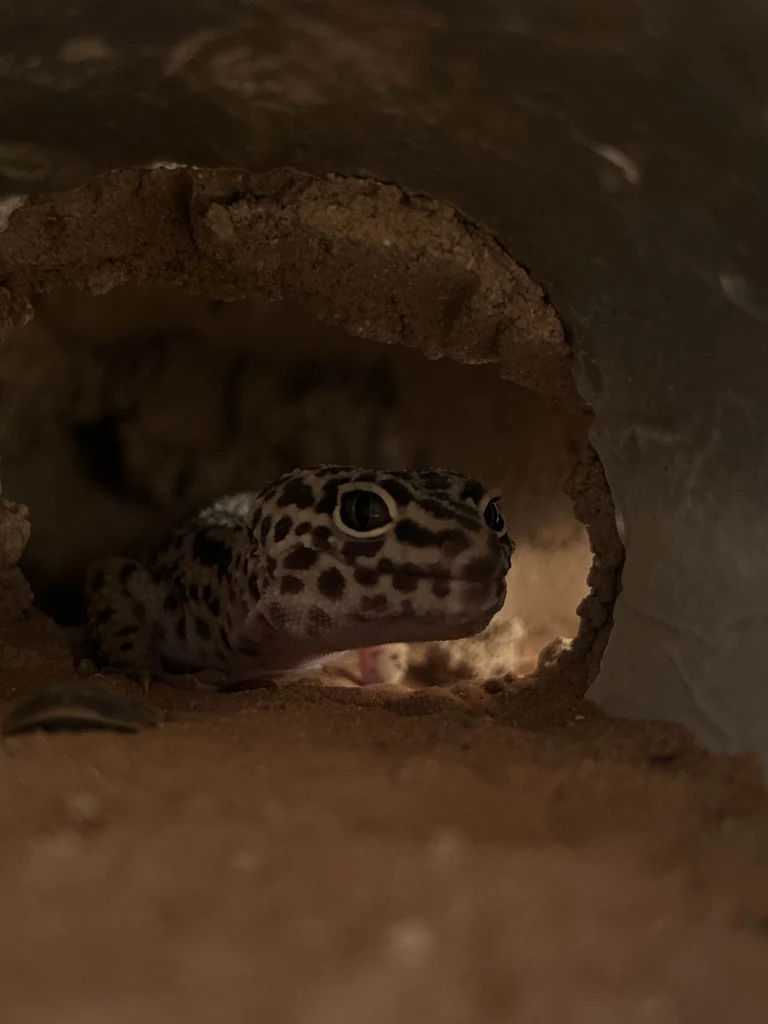
Leopard geckos are small, ground-dwelling lizards from the rocky, dry hills of Afghanistan, Pakistan, northwestern India, Iran, and Nepal. They shelter in crevices and under rocks during the day and come out at dusk and dawn to hunt insects — which is why they are called crepuscular (active at twilight rather than full daylight or deep night).
Unlike most geckos, leopard geckos cannot climb smooth glass. They have regular toes instead of the sticky toe pads that most geckos use to scale walls. They also have real movable eyelids — that is unusual for a gecko, and it is part of what makes them so expressive.
Leopard geckos are one of the most thoroughly captive-bred reptiles in the hobby. The captive lineage in the US stretches back over 40 years. Almost every leopard gecko available to buy in the US today was born here, not collected from the wild. Decades of selective breeding have produced hundreds of color variations — tangerine, albino, bold stripe, and many more — all the same species underneath.
They can live 15 to 20 years with good care — longer than most cats, and about the same as a medium-sized dog. That is worth knowing before you bring one home. A leopard gecko is a long-term commitment.
Hygiene note: Like all reptiles, leopard geckos can carry Salmonella bacteria without showing any signs of illness. Always wash your hands thoroughly with soap and water before and after handling, and keep the gecko away from your face. Children should always have an adult present when handling any reptile.
Wild range and status
Wild leopard geckos live across a broad band of arid and semi-arid rocky grassland and scrub from eastern Iran through Afghanistan and Pakistan into northwestern India and Nepal.
IUCN Red List status: Least Concern. Wild populations are not currently considered threatened. The species is not listed under CITES, so there are no permit requirements for interstate transport of captive-bred animals in the US.
The pet trade in leopard geckos is overwhelmingly captive-bred, which is good for wild populations. Even so, "Least Concern" is not the same as "abundant forever" — responsible sourcing still matters.
IUCN status verified: 2026-10-29. Review due: 2028-10-29.
Did you know?
- Wild leopard geckos reportedly avoid sandy areas. Their natural home is rocky and gravelly — the idea that sand is their "natural" substrate is a myth, and it matters for how you set up their enclosure.
- They store fat in their tails. A thick, healthy tail is a good sign. A thin or wasted tail is a health warning.
- A leopard gecko that drops its tail in self-defense can grow it back — but the new tail is different from the original, and regrowing it costs the gecko a lot of stored energy. Always support the gecko's body; never grab or hold it by its tail.
- Despite being described as nocturnal, leopard geckos can use UVB light to make vitamin D3. A 2020 peer-reviewed study confirmed this directly.
Why is this on the keeper side?
The conservation dossier side of Tevazirus is for species that are struggling to survive AND are under-represented in media coverage. The leopard gecko is IUCN Least Concern with wild populations that are not currently threatened, and it is one of the most widely kept and documented reptiles in the hobby. It does not meet the inclusion criteria for the dossier side, and it would be misleading to place it there. It lives here on the keeper side, where it belongs — with full care information and an honest account of its wild biology.
Salmonella, supervision, and safe handling
All reptiles — including leopard geckos — can carry Salmonella bacteria without showing any signs of illness. Salmonella infection in people can cause serious illness, especially in young children, elderly people, and anyone with a weakened immune system.
- Wash your hands with soap and water thoroughly before and after every handling session. Use soap, not just water.
- Keep the gecko away from your face — do not kiss or nuzzle the animal.
- Children must have an adult present at all times when handling any reptile.
- Do not handle reptiles near food preparation areas or near food or drink.
- Children under 5 should not handle reptiles — their immune systems are still developing and they are at higher risk.
If you or a family member develop symptoms of Salmonella infection (stomach cramps, diarrhea, fever) after contact with a reptile, contact a doctor and mention the animal contact.
Keeper care guide
Leopard gecko care guide
Researched: 2026-10-29 | Review due: 2027-10-29 | Vet review: Pending — this guide has not been independently reviewed by a veterinarian.
This care guide is for educational and informational purposes only. It is not veterinary advice. Leopard geckos and all reptiles have individual health needs that may differ from general guidance. Husbandry science evolves; check the review date above.
This guide is based on research from veterinary and scientific sources cited throughout (last checked: 2026-10-29). It has not been independently reviewed by a veterinarian. Tevazirus recommends an annual wellness exam with an exotic-specialist veterinarian for any reptile. Tevazirus does not endorse or take responsibility for the products, animals, or services of any third party mentioned or linked from this guide. If your animal shows signs of illness or distress, contact a veterinarian promptly.
0 Quick-reference card
Keep this nearby. If something looks wrong with your gecko, do not guess — see a vet.
| Topic | Tevazirus standard |
|---|---|
| Enclosure (adult, one gecko) | 36″ × 18″ × 18″ minimum floor area |
| Warm hide surface temp | 88–90°F (31–32°C) |
| Warm end ambient | 80–85°F (27–29°C) |
| Cool end | 70–77°F (21–25°C) |
| Nighttime low | 68°F minimum (20°C) |
| Humidity | 30–40% ambient (cool end) |
| Moist hide | Required at all times |
| Photoperiod | 12 hours light / 12 hours dark |
| Substrate (all ages) | Paper towels, tile, or reptile carpet as safe default |
| Substrate (juveniles under 6 months) | Paper towels only — no loose substrate |
| Feeding (juvenile) | Daily; gut-loaded insects |
| Feeding (adult) | Every 2–3 days; gut-loaded insects |
| Supplements | Calcium without D3 most feedings; calcium with D3 and multivitamin per schedule in §3.4 |
| Thermostat | Required on all heating elements |
| Hot rocks | Never |
| Handling | Wait 2 weeks before first handling; support the full body; never grab the tail |
| Wash hands | Before AND after every handling session |
| Annual vet visit | Yes — find an exotic-animal vet before you need one |
1 Commitment and what to expect
Plan for 15 to 20 years. Merck Veterinary Manual lists 20+ years as a normal captive lifespan for a well-kept gecko. The AnAge database records a maximum longevity of 28.5 years for the species in captivity. That is not a typical outcome, but it shows what is possible with good care. The practical planning horizon is 15 to 20 years. [C-07, C-15]
Leopard geckos are not social animals. They do not seek out human contact the way a dog does. A well-tamed gecko will tolerate handling — it will sit calmly in your hands, explore, and not panic. That is a good outcome. Patient, respectful taming produces a gecko that is a genuine pleasure to watch and interact with. Children should always have an adult present when handling. [C-13]
Sources: C-07 Merck Veterinary Manual (Divers et al.); C-15 AnAge database; C-13 ReptiFiles (cited by Merck Vet Manual as a keeper reference).
2 Setting up the enclosure
Enclosure size ~ sources differ
Tevazirus standard: 36″ × 18″ × 18″ minimum for one adult leopard gecko. [C-13, C-16, C-17, C-18, C-07]
Sources disagree on minimum size. The old 10-gallon figure still appears in some care sheets. It is outdated advice — a 10-gallon tank is not long enough to provide a proper thermal gradient. A gecko in a 10-gallon cannot choose between a warm end and a cool end, which is a basic welfare requirement. [C-13, C-19]
The floor space matters more than the height for a ground-dwelling species. Leopard geckos do not climb walls. A tall, narrow enclosure does not meet their needs. [C-04, C-13, C-17]
Enclosure type
Front-opening glass enclosures are the current standard recommendation. They allow you to approach from the side rather than from above, which is less startling to the gecko. A screen or mesh top is required for ventilation. Do not use an aquarium with a solid lid. [C-06, C-13]
Thermal gradient — three zones
Leopard geckos are ectotherms. They cannot regulate their own body temperature internally. The enclosure must give them a choice between warm and cool areas at all times. [C-07]
| Zone | Target |
|---|---|
| Warm hide (surface) | 88–90°F / 31–32°C |
| Warm end ambient | 80–85°F / 27–29°C |
| Cool end | 70–77°F / 21–25°C |
| Nighttime low | 68°F / 20°C minimum |
Place a digital thermometer at substrate level in both the warm zone and the cool zone. A thermometer on the side of the enclosure reads air temperature, not the surface temperature where the gecko actually sits. [C-13, C-20]
Heating equipment
All heating equipment must run on a thermostat. An unregulated heater can overheat, burn your gecko, and start a fire. This is not optional. [C-06, C-13, C-17]
Recommended heating: under-tank heater (UTH) or heat mat on the warm-end floor; low-level basking lamp or ceramic heat emitter for warm ambient zone; dimming thermostat for lamps, on/off thermostat for heat mats. Do not use heat rocks — they create hot spots that can cause burns. [C-06, C-13, C-17, C-18]
UVB lighting ~ sources differ
Most current veterinary sources recommend low-level UVB as beneficial. A 2020 peer-reviewed study confirmed that leopard geckos can synthesize vitamin D3 from UVB exposure. [C-14] Merck Veterinary Manual still lists leopard gecko lighting as "no special requirement" in its species table — it is the main exception among current professional sources. [C-07]
Tevazirus recommendation: Install low-level UVB (2.5–6% fluorescent tube, Ferguson Zone 1, UVI ~0.7 in the basking zone). Set it on the same 12-hour timer as the rest of the lighting. If you do not use UVB, you must compensate with more careful oral D3 supplementation — a herp vet should review that protocol. Use fluorescent UV tubes (T5 HO or T8), not LED "UVB" bulbs. [C-17, C-18, C-14, C-23]
Substrate — what is safe, what is not
HARD RULE — Juveniles under 6 months old: paper towels only. No loose substrate of any kind. [C-24, C-25, C-17, C-18, C-13]
Loose particle substrates are a documented cause of impaction — a potentially fatal gastrointestinal blockage from ingested material. Substrates to avoid: sand (any kind, including "calcium sand"), walnut shell, gravel, crushed coral, cedar or pine shavings (toxic), beech chips. [C-06, C-07, C-13, C-17, C-24]
Note on "calcium sand": sand sold as "digestible" or calcium-based is still not safe. [C-06]
Safe substrates (recommended for all keepers): paper towels, newspaper, reptile carpet or artificial turf, ceramic tile, flat rough stone. [C-06, C-07, C-13, C-17]
Hides — three minimum
Every enclosure needs: a warm hide (warm end, correct surface temp), a cool hide (cool end), and a moist/humid hide (warm end, filled with damp sphagnum moss or coconut fiber — essential for shedding). Change or refresh the moist hide substrate regularly to prevent mold. [C-06, C-13, C-17, C-18]
Water dish
Provide a shallow water dish, wide enough for the gecko to soak in but not deep enough to drown in. Change the water daily. [C-06, C-13]
Sources: C-06 VCA Animal Hospitals (Gregory Rich DVM); C-07 Merck Veterinary Manual; C-13 ReptiFiles; C-14 Oonincx et al. 2020 (peer-reviewed); C-16 Royal Veterinary College; C-17 RSPCA; C-18 Pender Veterinary Centre; C-23 PubMed 37870081 (peer-reviewed); C-24 ARAV trifold care sheet.
3 Feeding and nutrition
Leopard geckos are insectivores. They eat gut-loaded insects. They do not eat plants or fruit. [C-06, C-07, C-27]
Feeder insects
Staple feeders: gut-loaded crickets, dubia roaches. [C-06, C-27, C-28]
Variety feeders (occasionally): silkworms, black soldier fly larvae / phoenix worms (high in calcium), hornworms.
Treat foods (limit frequency): mealworms, superworms, waxworms (very high fat — useful for underweight geckos; not a regular food). [C-06, C-28]
Insect size rule: No feeder insect wider than the space between the gecko's eyes. An insect that is too large is a choking and impaction risk. [C-27, C-28]
No wild-caught insects — they can carry pesticides and parasites. [C-04, C-29]
Gut-loading
Gut-loading means feeding your feeder insects a nutritious diet for 24 to 48 hours before offering them to your gecko. Commercial feeder insects are often nutritionally poor, especially in calcium. Whatever the insect eats, the gecko gets. Good gut-load foods: collard greens, turnip greens, dandelion greens, carrot, sweet potato, commercial cricket diet. [C-06, C-27, C-28, C-30]
Feeding frequency ~ sources differ on supplementation
| Life stage | Frequency |
|---|---|
| Juvenile (under 12 months) | Daily |
| Adult (12 months and older) | Every 2–3 days |
Supplementation
All captive insectivore leopard geckos need three categories of supplement: (1) calcium without D3 — regular mineral support; (2) calcium with D3 — for D3 supplementation when UVB is absent or limited; (3) reptile multivitamin — must contain pre-formed vitamin A, not just beta-carotene. [C-06, C-07, C-27, C-28, C-30, C-31]
Treat the schedule below as a starting point and review with a herp vet — especially given the UVB variable:
| Without UVB | |||
|---|---|---|---|
| Life stage | Calcium (no D3) | Calcium + D3 | Multivitamin |
| Juvenile (<12 mo) | 5–7×/week | 2–3×/week | 1×/week |
| Adult (12 mo+) | 4–5×/week | 2×/week | Every 2 weeks |
| With UVB (Ferguson Zone 1, UVI ~0.7) | |||
|---|---|---|---|
| Life stage | Calcium (no D3) | Calcium + D3 | Multivitamin |
| Juvenile (<12 mo) | Most feedings | 1×/week | 1×/week |
| Adult (12 mo+) | Most feedings | 1×/week or less | Every 2 weeks |
Key cautions: vitamin D3 is fat-soluble and accumulates to toxic levels if oversupplemented — more is not better. Use a light dusting, not a heavy coating. Bring supplement labels to vet appointments. [C-30]
Sources: C-06 VCA; C-07 Merck; C-27 All Creatures Animal Clinic; C-28 MedVet; C-29 Exo Terra; C-30 Laguna Beach / Aliso Beach Animal Clinic; C-31 exopetguides.com.
4 Shedding and humidity
Leopard geckos shed their skin in one piece as they grow. A gecko that is about to shed may look dull or grey and will often stop eating for a day or two. This is normal. Do not handle during a shed cycle. [C-20, C-26]
The moist hide is the most important shed-support tool. It should always be in place — not just when you notice a shed coming. Fill it with damp (not wet) sphagnum moss, coconut fiber, or vermiculite. Refresh the substrate regularly to prevent mold. [C-06, C-13, C-17, C-18]
A warm, shallow soak (20–25 minutes in water that covers the gecko's body but not its head) can help loosen a stuck shed. Do not pick at or pull stuck shed — you can cause injury. [C-13, C-17]
If shed is stuck on toes and has not come off after a warm soak, see a vet. Time matters — retained shed on toes can cut off circulation and cause digit loss within days. Retained shed over the eyes must be removed by a veterinarian only — do not attempt this yourself. [C-17, C-13]
5 Handling and behavior
Wait at least 2 weeks before any handling when you bring a new gecko home. The gecko needs time to settle into the enclosure, eat, and decompress before you add the stress of handling. [C-13, C-17]
Safe handling technique: Scoop the gecko from below with both hands. Support all four feet. Never grab from above — it triggers a defensive response. Never hold or grab the tail — leopard geckos will drop their tail if they feel threatened. The tail does regrow, but incompletely, and the gecko must rebuild fat stores from scratch. Keep sessions to about 10–15 minutes maximum. [C-13]
Reading stress signals: If the gecko backs away, waves its tail, bites, or tries to escape, put it down. Do not keep pursuing it. Try again another day. Tail waving is a defense signal — a gecko that is comfortable will hold still or walk calmly across your hands.
Start with short sessions (5 minutes every other day) and build up gradually. Patience is the whole method. [C-13]
6 Health and vet care
Find an exotic-animal vet before your gecko is sick. Annual wellness exams for reptiles are standard good practice, not just an emergency measure. Leopard geckos hide illness well — many problems are detectable by a vet long before they become obvious to the keeper. [C-06, C-07, C-32]
A new gecko should have a fecal exam to check for parasites. Quarantine any new gecko in a separate space for at least 30 days. [C-06, C-24]
Finding a herp vet in Georgia: the ARAV (Association of Reptilian and Amphibian Veterinarians) veterinarian locator at arav.org is the best starting point. The University of Georgia College of Veterinary Medicine has an exotic animal clinical service.
Common health conditions
Metabolic bone disease (MBD): The most common serious and preventable condition in captive leopard geckos. Caused by chronic lack of calcium, vitamin D3, or both. Signs: muscle tremors, rubbery or soft limbs, bent or twisted bones, difficulty walking, jaw deformity, inability to eat, weight loss. Early-stage MBD is treatable; advanced MBD may not be. See a vet immediately if you see any of these signs. Prevention: correct supplementation, appropriate UVB, correct temperatures. [C-32, C-17, C-33, C-13]
Cryptosporidiosis ("stick tail disease"): Caused by the parasite Cryptosporidium varanii. Signs: chronic watery diarrhea, progressive weight loss despite eating, classic "stick tail" appearance (tail becomes wasted and thin), lethargy. This condition is highly contagious to other reptiles — isolate any suspected gecko immediately. Use separate enclosures, separate tools, and wash hands between animals. Treatment options are limited; paromomycin may ease symptoms but is not curative. Most affected geckos require lifelong management or euthanasia depending on disease severity. See a vet immediately if you see the signs above. Early detection through routine fecal exams gives the best possible options. [C-34, C-20]
Dysecdysis (incomplete shed): See Section 4 above. Retained shed on toes is time-sensitive; retained shed over eyes requires a vet visit. [C-17, C-13]
Impaction: Gastrointestinal blockage from ingested substrate or an oversized prey item. Signs: no defecation for more than one week combined with lethargy or abdominal swelling. A warm soak may help mild impaction; if no defecation after 24 hours of warm soaks plus lethargy or swelling, see a vet immediately. Largely preventable with correct substrate choice and correctly sized feeder insects. [C-17]
Mites: Visible as tiny moving specks around the eyes, ears, or neck folds. Require vet-prescribed treatment — over-the-counter products can harm the gecko. [C-17]
When to call the vet
- Rubbery or soft limbs, jaw deformity, tremors, difficulty walking
- No defecation for more than one week combined with lethargy or belly swelling
- Retained shed on toes that does not come off with a warm soak
- Any retained shed over the eyes
- Redness, swelling, or discharge in or around the mouth
- Watery or foul-smelling diarrhea, especially with weight loss or a wasting tail
- Wheezing, clicking, open-mouth breathing, or mucus from the nose
- Visible mites
- Weight loss despite eating, or refusal to eat beyond 2–3 weeks without an obvious reason
- Any sudden change in behavior, posture, or movement
Sources: C-13 ReptiFiles; C-17 RSPCA; C-20 PetMD; C-32 VetHelpDirect; C-34 Vet Times; C-06 VCA; C-07 Merck; C-24 ARAV trifold.
7 Sourcing your leopard gecko
Why captive-bred matters
Captive-bred (CB) leopard geckos are the right choice for almost every reason: wild populations are IUCN Least Concern but wild collection is still a drain on any population even when it is not currently threatened; CB geckos typically carry lower parasite loads; the US CB lineage is 40+ years old. [C-05, C-04, C-33]
Best: a reputable US CB breeder who maintains lineage records, participates in gecko community organizations, and exhibits at reptile shows. Georgia reptile shows (such as Repticon Atlanta) regularly feature breeder tables. Acceptable with due diligence: a reputable local reptile store selling documented CB stock. Avoid: imports of unknown origin, classified listings without CB documentation, any seller who cannot confirm captive-bred status.
Morph welfare note (keeper-community reported)
Some color morphs are reported in the keeper community to carry genetic conditions that affect welfare. The most documented example is Enigma Syndrome — a neurological condition reported by keepers in association with the enigma morph, causing circling, head-tilting, and disorientation. Several albino lines have also been associated with photosensitivity by experienced keepers. Ask about morph genetics before purchasing. These reports come from the keeper community, not settled peer-reviewed science as of 2026-10-29; ask a knowledgeable breeder or a herp vet about the morph you are considering.
Legal status — Georgia
Leopard geckos (Eublepharis macularius) are legal to keep as pets in Georgia without a special permit. They do not appear on Georgia DNR's list of restricted or prohibited exotic species. Always verify current regulations with Georgia DNR before acquiring any animal — regulations can change. [C-11, C-35]
Sources: C-04 Exo Terra; C-05 WARN; C-11 Georgia DNR; C-33 VetHelpDirect; C-35 Georgia Wildlife rules.
Sources and citations
- Tier A — Veterinary / Scientific / Government
- C-04 Exo Terra care guide. exo-terra.com/explore/care-guides/lizards/eublepharis-macularius/ — 2026-10-27
- C-06 VCA Animal Hospitals, Gregory Rich DVM: "Leopard Geckos: Care and Feeding." vcahospitals.com/know-your-pet/leopard-geckos-care-and-feeding — 2026-10-27
- C-07 Merck Veterinary Manual, Divers et al.: "Management and Husbandry of Reptiles." merckvetmanual.com — 2026-10-27
- C-09 CDC standard handwashing guidance for reptile contact. Standing.
- C-10 IUCN Red List: Eublepharis macularius — Least Concern. iucnredlist.org (confirmed via GBIF/Wikidata, 2026-10-29)
- C-11 Georgia DNR Law Enforcement: "Wild Animals/Exotics." gadnrle.org/exotics — 2026-10-27
- C-13 ReptiFiles: Leopard gecko care guide. reptifiles.com/leopard-gecko/care-guide/ (cited by Merck Vet Manual) — 2026-10-27 (Tier B, but Merck-endorsed)
- C-14 Oonincx DGAB et al. (2020): "The nocturnal leopard gecko uses UVb radiation for vitamin D3 synthesis." Comp Biochem Physiol B. PMID: 32950659. — 2026-10-27 (peer-reviewed)
- C-15 AnAge database: Eublepharis macularius, max longevity 28.5 years. genomics.senescence.info — 2026-10-29
- C-16 Royal Veterinary College / Beaumont Sainsbury Animal Hospital: "Leopard Gecko Care" factsheet, Dec 2024. rvc.ac.uk — 2026-10-27
- C-17 RSPCA: "How To Care For a Leopard Gecko." rspca.org.uk — 2026-10-27
- C-18 Pender Veterinary Centre: "Caring For Your Pet Leopard Gecko." pendervet.com — 2026-10-27
- C-20 PetMD (vet-reviewed): "Leopard Gecko Care Sheet" and "Stick Tail Disease." petmd.com — 2026-10-27
- C-23 PubMed 37870081 (2024): "UVB-emitting LEDs for reptile lighting: Identifying the risks." Zoo Biology 43(1). — 2026-10-27 (peer-reviewed)
- C-24 ARAV trifold care sheet (Dipl.ABVP, 2016): "How To Keep Your Leopard Gecko Healthy." amccorona.com — 2026-10-29
- C-27 All Creatures Animal Clinic: "Leopard Gecko." allcreaturesvet.net — 2026-10-27
- C-28 MedVet: "Leopard Gecko Information and Care Recommendations." medvet.com — 2026-10-27
- C-30 Laguna Beach / Aliso Beach Animal Clinic: "Leopard Gecko Care Guide." alisobeachanimalclinic.com — 2026-10-27
- C-32 VetHelpDirect: "What's wrong with my gecko?" vethelpdirect.com — 2026-10-27
- C-34 Vet Times: "Management, Care and Common Conditions of Leopard Geckos." vettimes.com — 2026-10-27
- C-35 Georgia Wildlife: "Rules Pertaining to Wild Animals." georgiawildlife.com/wild-animal-rules — 2026-10-27
- Tier B — Reputable keeper community
- C-05 World Animal Rescue Network: Leopard Gecko. worldanimalrescuenetwork.org — 2026-10-27
- C-19 Hudson Valley Reptile Rescue care guide. hvreptilerescue.org — 2026-10-27
- C-25 SpectrumCare: substrate guide. spectrumcare.pet — 2026-10-27
- C-26 smallpetexpert.com: substrate guide. smallpetexpert.com — 2026-10-27
- C-29 Exo Terra: care guide — no wild-caught insects. exo-terra.com — 2026-10-27
- C-31 exopetguides.com: supplementation schedule. exopetguides.com — 2026-10-27
- C-33 VetHelpDirect — parasites (same as C-32). vethelpdirect.com — 2026-10-27
Before you decide
Is a leopard gecko the right pet for you?
This section is not a sales pitch — it is a cool-down. Leopard geckos are genuinely rewarding animals to keep. They are also a 15-to-20-year commitment that requires consistent attention and a real upfront investment in equipment.
- Lifespan: 15 to 20 years. This gecko may outlive college, jobs, moves, and relationships. Plan for where it goes when life changes.
- Equipment cost: A proper setup (enclosure, thermostat, heating, UVB tube, hides, thermometers) costs several hundred dollars upfront. Cut-rate setups create welfare problems.
- Vet care: Find an exotic-animal vet before you need one. Leopard gecko vet visits are not as cheap or easy to access as dog and cat care. A fecal exam for a new gecko is recommended.
- What a leopard gecko is NOT: It is not a cuddle pet. It tolerates handling; it does not seek it out. It is not low-maintenance just because it is small. It is not a good first pet for a child who cannot yet reliably wash their hands after every contact.
- What a leopard gecko IS: A long-lived, fascinating animal with a distinct personality. Watching a tamed gecko hunt, explore, and go about its life in a well-designed enclosure is genuinely satisfying. It suits a keeper who finds animal behavior interesting and who is willing to learn the husbandry.