
Conservation dossier
Saola
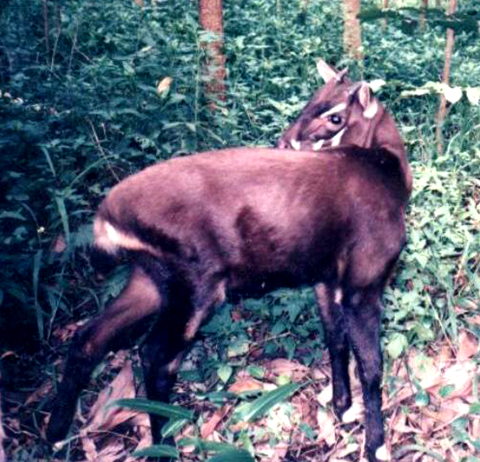
Pseudoryx nghetinhensisPhoto shown unmodified in the separate panel below. Photographer unrecorded; uploaded by Silviculture to Vietnamese Wikipedia, via Wikimedia Commons. CC BY-SA 3.0.

Full conservation dossier
Saola
Current status
Critically Endangered (IUCN; population trend: decreasing). IUCN’s assessment dated 27 November 2015, published in an amended version in 2020 and marked “Needs updating,” gives 25–750 mature individuals, with a best estimate of 50–300, and 5–15 locations. Current abundance is unknown. IUCN (2015; amended 2020) The latest confirmed wild camera-trap record reported by the sources reviewed is from 2013. Its continued survival and current numbers remain uncertain. Saola Foundation WWF record Sources reviewed 18 November 2026; population estimates retain their original dates.
Where they live
The Annamite Mountains straddling the border between Vietnam and Laos — a single, narrow, forested mountain range. The species has never been confirmed anywhere else.
Habitat
Saola inhabit wet evergreen and related forests of the Annamites, including lowland and lower montane habitats. Saola Foundation IUCN (2015; amended 2020)
Who they are
A bovid — a relative of cattle — with long, nearly parallel horns present in both sexes, up to about 55 cm. Saola Foundation A joint Vietnamese government–WWF survey found evidence of the species in 1992; its scientific description followed in 1993. WWF Saola Working Group Saola have survived only briefly in captivity; no captive population exists. Saola Foundation WWF record The name refers to the paired posts of a spinning wheel in Lao. Saola Working Group
How to recognize them
A bovid, not a deer, with a reddish-brown coat and distinctive white facial markings. Both sexes have long, nearly parallel horns. Large facial glands are thought to help communication. Saola Foundation Saola Working Group
Behavior & ecology
Saola appear largely solitary and browse forest vegetation; much of their ecology remains poorly documented. No individual has been studied in the wild under natural circumstances, according to the Saola Foundation. Saola Foundation Saola Working Group
Pressures
Indiscriminate wire snares set for other wildlife threaten saola. Commercial demand for wild meat and wildlife products, together with forest loss and improved access, intensifies the pressure. WWF Partners have proposed a conservation-breeding center at Bach Ma National Park. The sources reviewed do not confirm an operational facility holding saola. Re:wild Bach Ma plans (2020)
Sources
IUCN Red List species profile (e.T18597A166485696; assessed 27 November 2015, amended 2020, marked “Needs updating”). IUCN (2015; amended 2020) Saola Foundation — the Asian unicorn. Saola Foundation WWF — search for the elusive saola. WWF record Saola Working Group — what is a saola? Saola Working Group WWF — saola species page. WWF Re:wild — proposed conservation-breeding center. Re:wild Saola Working Group — Bach Ma plans reported in October 2020. Bach Ma plans (2020) Sources reviewed 18 November 2026; population estimates retain their original dates. No husbandry guidance is offered for this wild species — no captive population exists.
Help directly
Turn curiosity into action: choose a way to help below.
- Learn and act — Saola Foundation
Supports saola searches, research and conservation in the Annamite Mountains. - Learn and act — WWF — saola species page
WWF describes its work on forest protection, ranger capacity and reducing poaching. This link opens its external species-information page.
These links open independent organizations' websites. Inclusion does not imply a partnership or endorsement. Tevazirus does not collect donations through these links.
Ask an adult before donating, signing up, or sharing personal details. Watch wildlife from a safe distance; do not catch or handle it.
Take action
Help directly
Turn curiosity into action: choose a way to help below.
- Learn and act — Saola Foundation
Supports saola searches, research and conservation in the Annamite Mountains. - Learn and act — WWF — saola species page
WWF describes its work on forest protection, ranger capacity and reducing poaching. This link opens its external species-information page.
These links open independent organizations' websites. Inclusion does not imply a partnership or endorsement. Tevazirus does not collect donations through these links.
Ask an adult before donating, signing up, or sharing personal details. Watch wildlife from a safe distance; do not catch or handle it.
Sources & image credits
Sources
IUCN Red List species profile (e.T18597A166485696; assessed 27 November 2015, amended 2020, marked “Needs updating”). IUCN (2015; amended 2020) Saola Foundation — the Asian unicorn. Saola Foundation WWF — search for the elusive saola. WWF record Saola Working Group — what is a saola? Saola Working Group WWF — saola species page. WWF Re:wild — proposed conservation-breeding center. Re:wild Saola Working Group — Bach Ma plans reported in October 2020. Bach Ma plans (2020) Sources reviewed 18 November 2026; population estimates retain their original dates. No husbandry guidance is offered for this wild species — no captive population exists. Assessment authors: Timmins, Hedges & Robichaud.
Image credits
Photo panel: Saola (Pseudoryx nghetinhensis) — a living saola. Photographer unrecorded; uploaded by Silviculture to Vietnamese Wikipedia, via Wikimedia Commons. CC BY-SA 3.0. Original 480 × 462 image displayed unmodified; capture date, location and camera method unknown.
Keep exploring
Other endangered dossiers
Read more conservation dossiers or return to the full species index.